Advertisements
Advertisements
प्रश्न
In humans, sperm production occurs in the organ ______.
विकल्प
testes
scrotum
prostate gland
ovaries
vas deferens
ejaculatory duct
urinogenital duct
Advertisements
उत्तर
In humans, sperm production occurs in the organ testes.
Explanation:
The male reproductive system of humans consists of testes, various ducts, and glands. Sperm are produced in the testes of men from the beginning of maturation (puberty) till death.
APPEARS IN
संबंधित प्रश्न
Identify True/False statement. Correct false statement to make it true.
Spermatozoa get nutrition from Sertoli cells.
Fill in the blank:
The sac-like structure present outside the body and which contains testes is called _________.
Choose the correct answer:
Temperature of scrotum is ______________
With the help of labelled diagramms describe the structures of human sperm and unfertilized ovum.
A couple is unable to conceive. Which modern techniques are available to overcome this problem?
Explain the term Gametogenesis.
Write the functional activity of the following structure:
Seminal fluid
Find an odd one out.
State names of organs in male reproductive system.
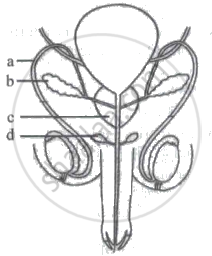
Identify the labels (a, b, c, and d) in the given diagram of the male reproductive system.
The correct sequence of spermatogenetic stages leading to the formation of sperms in a mature human testis is ______.
The function of the secretion of prostate gland is to ______.
Seminal plasma in human males is rich in ______.
Seminal plasma, the fluid part of semen is formed by ______.
Mark the odd one.
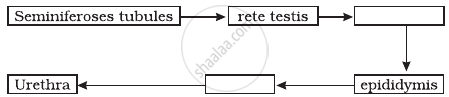
The path of sperm transport is given below. Provide the missing steps in blank boxes.
Explain the function of the following structure in the human male reproductive system.
Scrotum
Answer the following question based on the human male reproductive system:
By which type of cell division, sperms are formed?
Answer the following question based on the human male reproductive system:
Name any two unpaired organs of male reproductive system
Name these:
3 male accessory glands in humans.
Statement I: Vas deferens receives a duct from seminal vesicle and opens into urethra as the ejaculatory duct.
Statement II: The cavity of the cervix is called cervical canal which along with vagina forms birth canal.
In the light of the above statements, choose the correct answer from the options given below:
