Advertisements
Advertisements
प्रश्न
Draw a neat and labelled diagram.
Human male reproductive organs
Advertisements
उत्तर

APPEARS IN
संबंधित प्रश्न
Define Spermatogenesis.
Given alongside is a diagram of male reproductive system in humans. Label the parts indicated by numbers 1 to 5, and state their functions.

Name the following:
The tubular knot fitting like a cap on the upper side of the testis.
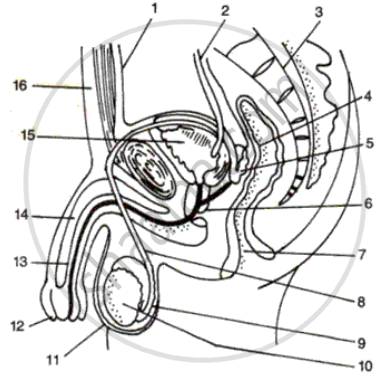
Given on the right is a diagram which represents the reproductive organs of a man:
(i) Write the names of the parts numbered 1 to 16.
(ii) Give two functions of the part 6.
(iii) Name three components of the fluid which may be found in the tube labeled 2.
(iv) What is the main function of the part labelled 3?
Complete the following statement by choosing the correct alternative:
Male copulatory organ ______.
Given below is the schematic diagram of the sectional view of the human male reproductive system.

State the functions of the parts numbered 1, 2, 3, 5, 8 and 11.
Given below is a diagram of the lateral section of the testis of a man. Study the same and answer the questions that follow:

(i) Label the parts numbered 1 to 4 of the diagram.
(ii) State the functions of the parts labeled 1 and 3.
(iii)What is the significance of the testes being located in the scrotal sac outside the abdomen?
(vi)What is the role played by the inguinal canal?
(v) What is semen?
Name the Following
The tubular knot fitting like a cap on the upper surface of the testes.
Hormones related to male reproductive system.
How is the semen produced?
The increased level of estrogen and progesterone is responsible for menstruation.
Which of the following is a secondary sexual character observed in males?
lf vasectomized man attempts to rape, then the presence of which of the following confirms it?
Spermatids are transformed into sperm by a process called ______.
Male hormone is produced in the testis by cells of ______.
ells of Leydig occur in ______.
Small sac-like muscular structures that enclose testes.
Given below is a certain situation. Analyze and describe its possible impact on a person:
Prostate and seminal vesicles are not functional.
The scrotum maintains a temperature how much lower than normal body temperature?
The penis is composed of which type of tissue that enables erection during insemination?
