Advertisements
Advertisements
प्रश्न
Given below is the schematic diagram of the sectional view of the human male reproductive system.

State the functions of the parts numbered 1, 2, 3, 5, 8 and 11.
Advertisements
उत्तर
Functions of
i) Seminal vesicles
They produce the fluid which serves as the
transporting medium for sperms.
ii) Prostate gland
It produces an alkaline secretion which mixes with the semen and helps neutralise the vaginal acids.
iii) Bulbo-urethral gland
It produces a secretion which serves as a lubricant for the semen to pass through the urethra.
iv) Testis
It produces the male gamete sperm and the male sex hormone testosterone.
v) Vas deferens
They carry the sperms from the epididymis to the urethra.
vi) Urethra
It serves as an outlet for delivering the sperms into the vagina.
संबंधित प्रश्न
____________ contribute about 60% of the total volume of the semen.
The exact location of the seminal vesicle
Given below is the schematic diagram of the sectional view of the human male reproductive system.
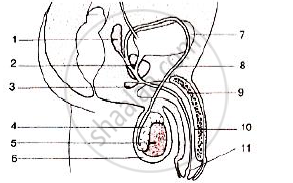
Name the parts numbered 1-11.
Given below is the outline of the male reproductive system. Name the parts labelled 1 to 8 and state their functions. Also name the corresponding structure of part (4) in the female reproductive system.

Complete the following sentences with appropriate word:
The surgical sterilization of males is known as _________.
Identify the INCORRECTLY labelled structure in the given diagram of the male reproductive system.
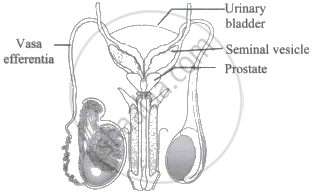
The correct sequence of organs in the male reproductive system for transport of sperms is
Sketch and label Human Male Reproductive System.
State very briefly the chief function of the following:
Seminal vesicles
State very briefly the chief function of the following:
Sperm duct (vas deferens)
