Advertisements
Advertisements
प्रश्न
Differentiate between spermatogenesis and spermiogenesis.
Advertisements
उत्तर
| Sr. No. | Feature | Spermatogenesis | Spermiogenesis |
| 1. | Definition | It is the complete process of the formation of mature male gametes (spermatozoa) from diploid spermatogonia. | It is the final stage of spermatogenesis, where non-motile spermatids are transformed into motile spermatozoa. |
| 2. | Nature of Process | This process involves both mitotic and meiotic cell divisions to increase the cell count. | This process involves no cell division; it is only a structural metamorphosis or differentiation of cells. |
| 3. | Outcome | It starts with a single diploid cell and results in the formation of four haploid spermatids. | It results in the conversion of a round, heavy spermatid into an elongated, light, and functional sperm. |
| 4. | Key Changes | It involves stages of multiplication, growth, and maturation to form various intermediate cell types. | It involves specific changes like acrosome formation, nucleus condensation, and the development of a tail. |
संबंधित प्रश्न
What are the major functions of male accessory ducts and glands?
What is the full form of IVF?
Give appropriate biological/technical terms for the following:
The accessory gland in human males whose secretion activates the
sperms.
Given below is the schematic diagram of the sectional view of the human male reproductive system.
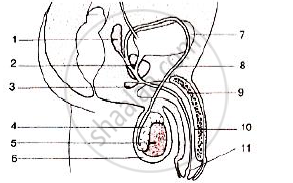
Name the parts numbered 1-11.
With the help of labelled diagramms describe the structures of human sperm and unfertilized ovum.
A couple is unable to conceive. Which modern techniques are available to overcome this problem?
Name the Following
The site of production of sperms in man.
Write the functional activity of the following structure:
Cowper’s gland
State names of organs in male reproductive system.
What is the enzyme present in the acrosome of sperm?
The spermatozoa from seminiferous tubules pass into ______.
In the following diagram, what are A and its function?

What is the significance of epididymis in male fertility?
Which of the following provides a proof for forensic test in case of rape?
In humans, sperm production occurs in the organ ______.
Draw a labelled diagram of the male reproductive system.
State very briefly the chief function of the following:
Sperm duct (vas deferens)
Choose the odd one out from the group of terms given below and write the category for the remaining terms:
Can there be any abnormal situation regarding testes location? If so, what is that and what is the harm caused due to it?
What percentage of total semen volume does the prostate gland contribute?
What is the enlarged tip of the penis called?
