Advertisements
Advertisements
Question
Determine the maximum value of Z = 11x + 7y subject to the constraints : 2x + y ≤ 6, x ≤ 2, x ≥ 0, y ≥ 0.
Advertisements
Solution
Given that: Z = 11x + 7y and the constraints 2x + y ≤ 6, x ≤ 2, x ≥ 0, y ≥ 0
Let 2x + y = 6
| x | 0 | 3 |
| y | 6 | 0 |
The shaded area OABC is the feasible region determined by the constraints
2x + y ≤ 6
x ≤ 2
x ≥ 0
y ≥ 0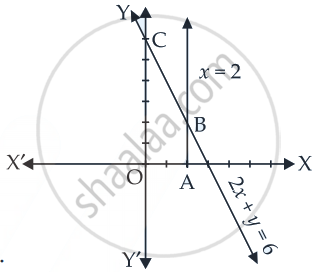
The feasible region is bounded.
So, maximum value will occur at a corner point of the feasible region.
Corner points are (0, 0), (2, 0), (2, 2) and (0, 6).
Now, evaluating the value of Z, we get
| Corner points | Value of Z | |
| O(0, 0) | 11(0) + 7(0) = 0 | |
| A(2, 0) | 11(2) + 7(0) = 22 | |
| B(2, 2) | 11(2) + 7(2) = 36 | |
| C(0, 6) | 11(0) + 7(6) = 42 | ← Maximum |
Hence, the maximum value of Z is 42 at (0, 6).
APPEARS IN
RELATED QUESTIONS
Solve the following Linear Programming Problems graphically:
Maximise Z = 5x + 3y
subject to 3x + 5y ≤ 15, 5x + 2y ≤ 10, x ≥ 0, y ≥ 0
Solve the following Linear Programming Problems graphically:
Minimise Z = x + 2y
subject to 2x + y ≥ 3, x + 2y ≥ 6, x, y ≥ 0.
Show that the minimum of Z occurs at more than two points.
Minimise and Maximise Z = 5x + 10 y
subject to x + 2y ≤ 120, x + y ≥ 60, x – 2y ≥ 0, x, y ≥ 0.
Show that the minimum of Z occurs at more than two points.
Minimise and Maximise Z = x + 2y
subject to x + 2y ≥ 100, 2x – y ≤ 0, 2x + y ≤ 200; x, y ≥ 0.
Show that the minimum of Z occurs at more than two points.
Maximise Z = – x + 2y, Subject to the constraints:
x ≥ 3, x + y ≥ 5, x + 2y ≥ 6, y ≥ 0.
A dietician wishes to mix together two kinds of food X and Y in such a way that the mixture contains at least 10 units of vitamin A, 12 units of vitamin B and 8 units of vitamin C. The vitamin content of one kg food is given below:
| Food | Vitamin A | Vitamin B | Vitamin C |
| X | 1 | 2 | 3 |
| Y | 2 | 2 | 1 |
One kg of food X costs Rs 16 and one kg of food Y costs Rs 20. Find the least cost of the mixture which will produce the required diet?
An aeroplane can carry a maximum of 200 passengers. A profit of Rs 1000 is made on each executive class ticket and a profit of Rs 600 is made on each economy class ticket. The airline reserves at least 20 seats for executive class. However, at least 4 times as many passengers prefer to travel by economy class than by the executive class. Determine how many tickets of each type must be sold in order to maximize the profit for the airline. What is the maximum profit?
To maintain his health a person must fulfil certain minimum daily requirements for several kinds of nutrients. Assuming that there are only three kinds of nutrients-calcium, protein and calories and the person's diet consists of only two food items, I and II, whose price and nutrient contents are shown in the table below:
| Food I (per lb) |
Food II (per lb) |
Minimum daily requirement for the nutrient |
||||
| Calcium | 10 | 5 | 20 | |||
| Protein | 5 | 4 | 20 | |||
| Calories | 2 | 6 | 13 | |||
| Price (Rs) | 60 | 100 |
What combination of two food items will satisfy the daily requirement and entail the least cost? Formulate this as a LPP.
Maximise Z = 3x + 4y, subject to the constraints: x + y ≤ 1, x ≥ 0, y ≥ 0
Maximise the function Z = 11x + 7y, subject to the constraints: x ≤ 3, y ≤ 2, x ≥ 0, y ≥ 0.
The feasible region for a LPP is shown in Figure. Find the minimum value of Z = 11x + 7y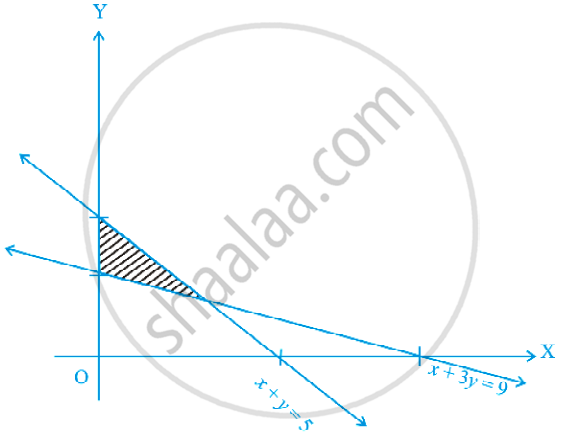
Refer to Exercise 7 above. Find the maximum value of Z.
The feasible region for a LPP is shown in figure. Evaluate Z = 4x + y at each of the corner points of this region. Find the minimum value of Z, if it exists.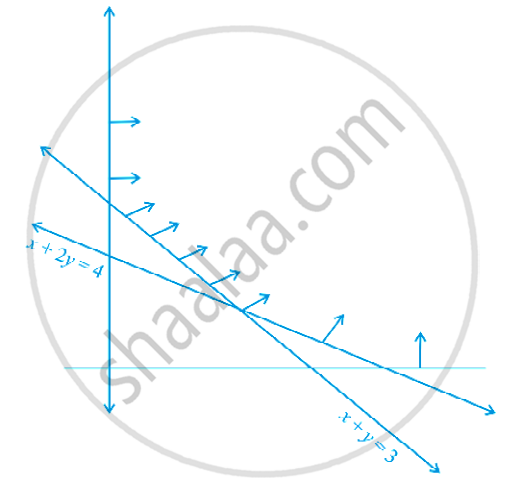
Refer to quastion 12. What will be the minimum cost?
Refer to question 14. How many sweaters of each type should the company make in a day to get a maximum profit? What is the maximum profit.
A company makes 3 model of calculators: A, B and C at factory I and factory II. The company has orders for at least 6400 calculators of model A, 4000 calculator of model B and 4800 calculator of model C. At factory I, 50 calculators of model A, 50 of model B and 30 of model C are made every day; at factory II, 40 calculators of model A, 20 of model B and 40 of model C are made everyday. It costs Rs 12000 and Rs 15000 each day to operate factory I and II, respectively. Find the number of days each factory should operate to minimise the operating costs and still meet the demand.
In a LPP, the linear inequalities or restrictions on the variables are called ____________.
If the feasible region for a LPP is ______ then the optimal value of the objective function Z = ax + by may or may not exist.
A corner point of a feasible region is a point in the region which is the ______ of two boundary lines.
Maximum value of the objective function Z = ax + by in a LPP always occurs at only one corner point of the feasible region.
In a LPP, the minimum value of the objective function Z = ax + by is always 0 if the origin is one of the corner point of the feasible region.
In the given graph, the feasible region for an LPP is shaded. The objective function Z = 2x – 3y will be minimum at:

A linear programming problem is one that is concerned with ____________.
In linear programming, optimal solution ____________.
If two corner points of the feasible region are both optimal solutions of the same type, i.e., both produce the same maximum or minimum.
In a LPP, the objective function is always ____________.
The feasible region for an LPP is shown shaded in the figure. Let Z = 3x - 4y be the objective function. Minimum of Z occurs at ____________.

Maximize Z = 10×1 + 25×2, subject to 0 ≤ x1 ≤ 3, 0 ≤ x2 ≤ 3, x1 + x2 ≤ 5.
The feasible region for an LPP is shown shaded in the following figure. Minimum of Z = 4x + 3y occurs at the point.
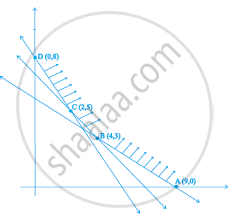
Which statement best describes a Linear Programming Problem (LPP)?
In the expression \[Z=250x+75y\], which quantities are the decision variables?
