Advertisements
Advertisements
Question
Describe the shifts in the narration of the events as indicated in the three sections of the text. Give a subtitle to each section.
Advertisements
Solution
The first section: The first section opens on a cheerful note. The narrator and his family are all set for their ultimate dream- to take up an around-the-world voyage like Captain James Cook did. They have perfected their seafaring skills. They begin the voyage and despite the bad weather, they celebrate Christmas on the ‘Wavewalker’.
The second section: This part of the narration covers the hazards faced by the voyagers. There is a shift in the narration from cheerful to intense. They find themselves in an extremely fatal and disastrous situation. A huge wave hits their boat and the narrator is thrown overboard. Despite getting injured, he maintains his composure and applies every possible way to tackle the critical situation. They manage to pump out the maximum amount of water out of the boat in about 36 hours. But as they continue to face bad weather conditions the narrator loses hope. The children remain fearless, courageous, and optimistic throughout.
The third section: The children provide moral support to the narrator and he continues with his efforts. Under the captaincy of the narrator, they manage to reach Ile Amsterdam. The narrator proves his seamanship and receives the title of “the best daddy” and “the best captain” from his children.
The above three sections can be titled as follows:
a) The first section: Round-the-world voyage begins
b) The second section: The attack of the big wave
c) The third section: Ultimate victory
APPEARS IN
RELATED QUESTIONS
How does Anne criticize the attitude of the grown-ups in her diary?
Answer any six of the following questions in 30‒40 words:
(a) Why did Gandhiji feel that taking the Champaran case to the court was useless?
(b) Why did the peddler derive pleasure from his idea of the world as a rattrap?
(c) How is Mukesh different from the other bangle makers of Firozabad?
(d) What tempted Franz to stay away from school?
(e) Why did the maharaja ban tiger hunting in the state?
(f) How was the skunk's story different from the other stories narrated by Jack?
(g) Which words of her brother made a deep impression on Bama?
Anne's relationship with her mother was never simple. What created the tension and discord? Why
Read the passage given below and answer the questions that follow:
The term dietary fibres refers collectively to indigestible carbohydrates present in plant foods. The importance of these dietary fibres came into the picture when it was observed that the people having diet rich in these fibres, had low incidence of coronary heart disease, irritable bowel syndrome, dental caries and gall stones.
The foodstuffs rich in these dietary fibres are cereals and grains, legumes, fruits with seeds, citrus fruits, carrots, cabbage, green leafy vegetables, apples, melons, peaches, pears etc.
These dietary fibres are not digested by the enzymes of the stomach and the small intestine whereas most of other carbohydrates like starch and sugar are digested and absorbed. The dietary fibres have the property of holding water and because of it, these get swollen and behave like a sponge as these pass through the gastrointestinal tract. The fibres add bulk to the diet and increase transit time in the gut. Some of these fibres may undergo fermentation in the colon.
In recent years, it has been considered essential to have some amount of fibres in the diet. Their beneficial effects lie in preventing coronary heart disease, and decreasing cholesterol level. The fibres like gums and pectin are reported to decrease postprandial (after meals) glucose level in blood. These types of dietary fibres are recommended for the management of certain types of diabetes. Recent studies have shown that the fenugreek (Methi) seeds, which contain 40 per cent gum, are effective in decreasing blood glucose and cholesterol levels as compared to other gum containing vegetables.
Some dietary fibres increase transit time and decrease the time of release of ingested food in colon. The diet having less fibres is associated with colon cancer and the dietary fibres may play a role in decreasing the risk of it.
The dietary fibres hold water so that stools are soft, bulky and readily eliminated. Therefore high fibre intake prevents or relieves constipation.
The fibres increase motility of the small intestine and the colon and by decreasing the transit time there is less time for exposure of the mucosa to harmful toxic substances. Therefore, there is a less desire to eat and the energy intake can be maintained within the range of requirement. This phenomenon helps in keeping a check on obesity. Another reason in helping to decrease obesity is that the high-fibre diets have somewhat lower coefficients of digestibility.
The dietary fibres may have some adverse effects on nutrition by binding some trace metals like calcium, magnesium, phosphorus, zinc and others and therefore preventing their proper absorption. This may pose a possibility of nutritional deficiency especially when diets contain marginal levels of mineral elements. This may become important constraints on increasing dietary fibres. It is suggested that an intake of 40 grams dietary fibres per day is desirable.
(Extracted from ‘The Tribune’)
(a) On the basis of your reading of the above passage make notes on it in points only, using recognizable abbreviations wherever necessary. Also suggest a suitable title.
(b) Write a summary of the above in about 80 words.
Attempt a character sketch of Margot Frank as shown in ‘The Diary of a Young Girl’.
Read the extract and do the following activities :
B1 Likes and dislikes :
(i) The child likes eating _______
(ii) The child dislikes eating _______
They won’t eat peas, don’t like your bread -
For something in it crunches;
They gag on fat, the gravy’s gross,
They won’t eat grapes in bunches.
Tomatoes, onions, peppers, fish
Garlic nor cottage cheese;
Oh, it’s a dish uncommon rare
That truly seems to please.
No red sauce may the ice cream have,
“It’s bleeding,” they will say;
And gravely hand it to their mum
To take it to clean away
But let us speak of chocolate cake,
It must be frosted o’er;
They’ll devour three full slabs,
And calmly ask for more.
Oh, I do so always love to eat
With picky little pests,
Whose parents joy to make them
The most undesirable guests!
B2 What message does the poem convey for children?
B3 Pick out two pairs of rhyming words from the poem.
Answer the following question in 150-200 words:
How did Miss Sullivan help Helen Keller when she was studying at Cambridge School?
Discuss in groups of four.
The sensitive behaviour of hill-folk.
The peacock is a colourful bird. How does the poem capture the various colours that its plumage displays?
You know what ‘hide-and-seek’ is. What would ‘hide-and-speak’ mean?
Discuss in pairs or in small groups
The description of novels as organisms.
Read the following statement and mark those that apply to you.
I have a small group of close friends and have no wish to interact with anyone else.
Fill in the blank.
The author wanted to grow ______________.
Find from the story one word for the following.
a low constant sound made by cats ______
Think and answer in your own words.
What could be the age group of the speaker in the poem?
Say why the speaker of the poem wishes to be a -
gardener
complete the following sentence.
Ajoy reported about ________________.
Some poets do not use uniformity in rhyming words, nor a steady rhythm. Such poems with no uniformity in rhyme, rhythm, length of lines or stanzas are called Free Verse. Walt Whitman, Ezra Pound, T.S. Eliot, Rabindranath Tagore are some famous poets who have composed poems in Free Verse.
A quick glance at the poem ‘Vocation' reveals that the style used by Tagore is Free Verse.
Now turn the pages of your textbook and see if you can find other poems in Free Verse.
Find evidence from the lesson and write in your own words.
We Indians are obsessed with foreign things.
Read the descriptions of the following from the story and describe any one of them using your own words.
- The ivy vine
- Behrman
- The last leaf that Johnsy saw
‘The city now, doth, like garment wear’. The poet imagines that the city is wearing a beautiful garment. Hence, the figure of speech is personification. Find out more examples of personification from the poem.
Say where . . . . . . .
______ do the cows and sheep stand?
Given below are some words from legal terminology used in court affairs. Discuss and complete the table accordingly.
| Sr. No | Legal Terminology | Description |
| 1. | Affidavit | A written statement confirmed by oath or affirmation for use as evidence in court. |
| 2. | Argument | |
| 3. | Consent | |
| 4. | Counsel | |
| 5. | Judgement | |
| 6. | Trial | |
| 7. | Verdict | |
| 8. | Contempt of Court | |
| 9. | Notice | |
| 10. | Stay order |
Read the lesson and name the following.
The First surgeon to perform operations ______
Imagine that you wish to organize a cultural event at your college. Prepare your own web-chart to indicate the qualities that you expect to have in a compere.
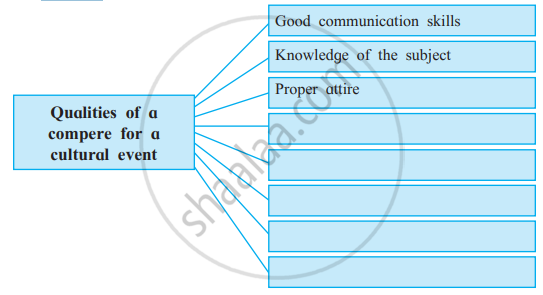
Correct the given sentence with justification.
Since there is a reference to the Indian boy, there are some scenes from India too.
Read the following sentence aloud. Write who said it and to whom.
“Look, here’s something for you.”
What do the following events/actions tell us about the characters? Discuss.
Sir Ector asked Sir Kay to show him whether he could draw the sword out of the stone.
Sayali was travelling in space for the first time.
Sayali did not understand the mistake she had made.
Write in your own words.
Who does the poet invite to join him?
Find from the Internet and write down.
Which character from the play sings this song?
Write in your own words.
What does the poet miss?
List 5 of the sounds that you like.
How was Gulliver taken to the city?
When do the parents feel sorry and become unhappy?
What did Ahmad tell Kasim when he dug a channel and began to draw water?
How was the young seagull’s first attempt to fly?
What did the narrator think the unusual sound was?
Why did Chulong catch the bird?
What commotion did the boomerang cause in the neighborhood?
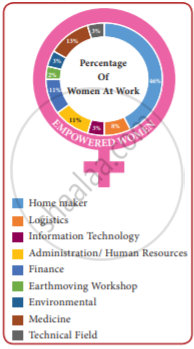
Read the data below and answer the following question.
Choose the correct answer.
What is the difference between the percentage of women working in logistics and Medicine?
What were the children doing beside the stone wall?
Why does the poet tell us to speak gently to young children?
What makes us happy and free, according to the poet?
Match the following.
| 1. | A man of ease | Emanuel |
| 2. | John’s trainer | Lalli and Lolly |
| 3. | Mathew’s secretary | John Mathew |
| 4. | John’s chef | Louise |
| 5. | Mathew’s friends | Basky |
The terrorists asked Neerja to collect the passports of the passengers because ______.
Amuthan locked the door behind him.
What were Anandhan and Yazhini watching in the television?
What happened to the two girls at the end of the war?
Jaswant was captured alive.
_______ is our culture.
Look at the picture and tick Choose the correct word.

All the children wished to go to the______.
Where did the tanker man take the water from the village?
Senthil bought a ______ from his savings.
Write the word with same meaning.

purse- ______
Why is your nose important for you?
Why is it not advisable to play online games?
