Advertisements
Advertisements
Question
Define the following:
Parthenogenesis
Advertisements
Solution
Parthenogenesis: It is a type of asexual reproduction in which a female gamete or egg cell develops into an individual without fertilization.
RELATED QUESTIONS
State the changes that take place in the uterus when Female gamete/egg is not fertilised
The diagram given below is that of a developing human foetus. Study the diagram and then answer the questions that follow:
- Label the parts numbered 1 to 3 in the diagram.
- Mention any two functions of the part labelled 2 in the diagram.
- Explain the significance of the part numbered 3 in the diagram.
- Define the term ‘Gestation’. What is the normal gestational period of the developing human embryo?
- Mention the sex chromosomes in a male and female embryo.

Match the Column:
| no | Column A | Column B |
| 1 | Allele | Control of automobile exhaust |
| 2 | Leydig cells | Tourniquet |
| 3 | Utriculus | Alternate forms of genes |
| 4 | Snake bite | Dynamic equilibrium |
| 5 | Euro IV norms | Testosterone |
| Sudden change in genes | ||
| Static equilibrium |
Do all organisms give birth to individuals like humans?
What is the frequency of menstrual cycle in human females (or women)?
What is the name of the narrow opening between the uterus and the vagina.
What is the function of the placenta?
In a flower, the parts that produce male and female gametes are respectively :
(a) sepal and anther
(b) filament and stigma
(c) anther and ovary
(d) stamen and style
The normal body cell of an organism contains 28 pairs of chromosomes. The number of chromosomes present in its germ cell will be:
Given below is a diagram of two systems together in the human body.
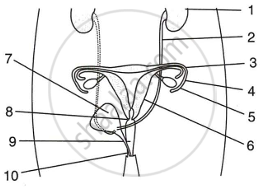 |
- Name the systems.
- Name the parts numbered 1-10.
- Describe the functions of the parts 3, 4, 5 & 6.
- What will happen if the part 3 on both sides gets blocked?
Describe in brief the role of testis in human male reproductive system.
Define the following:
Sexual reproduction
Differentiate on the basis of what is indicated in brackets :
The prostate gland and Cowper’s gland (the nature of secretion)
Define the four stages in the uterine cycle.
Differentiate
Sexual Reproduction and Asexual Reproduction.
The male homologue of the female clitoris is ____________.
What is inhibin?
Testosterone is produced by:
Gestation period in man
Which stage of human reproduction involves the fusion of sperm and egg to form a zygote?
