Advertisements
Advertisements
Question
The normal body cell of an organism contains 28 pairs of chromosomes. The number of chromosomes present in its germ cell will be:
Options
28
14
56
42
Advertisements
Solution
14
Explanation:
A germ cell has 14 pairs of chromosomes, i.e., half the number of chromosomes present in the normal body cell of an organism.
RELATED QUESTIONS
Name any three parts of the female reproductive system in human beings. Write one function of each.
The diagram given below is that of a developing human foetus. Study the diagram and then answer the questions that follow:
- Label the parts numbered 1 to 3 in the diagram.
- Mention any two functions of the part labelled 2 in the diagram.
- Explain the significance of the part numbered 3 in the diagram.
- Define the term ‘Gestation’. What is the normal gestational period of the developing human embryo?
- Mention the sex chromosomes in a male and female embryo.

Choose the ODD one out from the following terms given and name the CATEGORY to which the others belong:
Prostate gland, Cowper’s gland, seminal vesicle, seminiferous tubules.
What are the female sex cells in humans called?
Where does fertilisation take place in human females?
When a fertilised egg E formed in the oviduct of a human female divides repeatedly to form an embryo, the embryo gets implanted in the thick and soft lining of the uterus. After this a disc-like special tissue T develops between the uterus wall and embryo through which all the requirements of the developing embryo (and foetus) are met from the mother's body, The embryo is connected to the tissue T through a string like structure S.
(a) What is the other name of fertilised egg cell E?
(b) What is the name of tissue T?
(c) Name the string-like structure S.
(d) Name two substances which pass from mother's blood to embryo through tissue T and, one type of substance which passes from embryo to mother's blood.
(e) What happens to S when the baby is born? Why?
Write two examples of sexually transmitted diseases caused by virus.
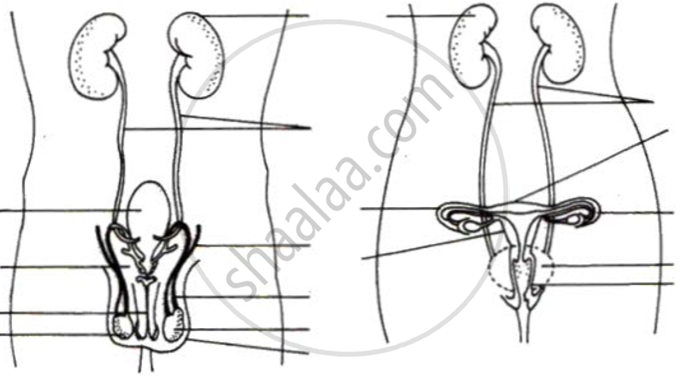
Label the folowing diagram
Choose the Odd One Out:
The membranous cover of the ovum at ovulation is ______.
