Advertisements
Advertisements
Question
Decide which of the following statement is true and which is false. Give reasons for your answer.
A point whose x-coordinate is zero, will lie on the y-axis.
Advertisements
Solution
The examples of points having x-coordinate as zero are (0,3), (0,6), (0,9). This can be represented in the following manner:
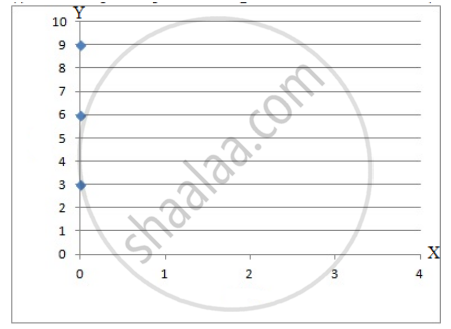
From the figure, it can be seen that these points lie on the y-axis. Hence, the statement is true.
RELATED QUESTIONS
Draw the line passing through (2, 3) and (3, 2). Find the coordinates of the points at which this line meets the x-axis and y-axis.
Locate the points:
(2, 1), (2, 2), (2, 3), (2, 4)
Write the coordinates of each of the vertices of each polygon in Fig. 27.9.
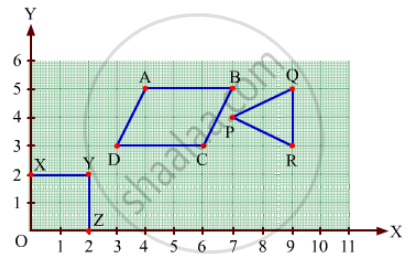
Decide which of the following statements is true and which is false. Give reasons for your answer.
A point whose y-coordinate is zero, will lie on x-axis.
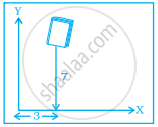
In the given figure the position of the book on the table may be given by ______.
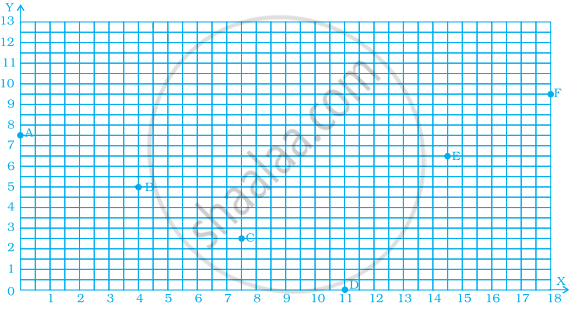
Find the coordinates of all letters in the graph given below.
Write the x-coordinate (abscissa) of the given point.
(0, 5)
Locate the points A(1, 2), B(3, 4) and C(5, 2) on a graph sheet taking suitable axes. Write the coordinates of the fourth point D to complete the rhombus ABCD. Measure the diagonals of this rhombus and find whether they are equal or not.
Locate the points P(3, 4), Q(1, 0), R(0, 4), S(4, 1) on a graph sheet and write the coordinates of the point of intersection of line segments PQ and RS.
