Advertisements
Advertisements
Question
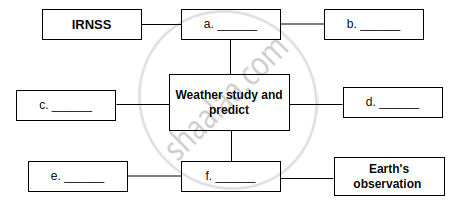
Complete the Following table.
| Sr. no. | Type of Satellite | The names of Indian Satellite and launcher |
| (1) | Navigational Satellite | Satellite: ______ |
| Launcher: ______ | ||
| (2) | Earth Observation Satellite | Satellite: ______ |
| Launcher: ______ |
Advertisements
Solution
| Sr. no. | Type of Satellite | The names of Indian Satellite and launcher |
| (1) | Navigational Satellite | Satellite: IRNSS |
| Launcher: PSLV | ||
| (2) | Earth Observation Satellite | Satellite: IRS |
| Launcher: PSLV |
APPEARS IN
RELATED QUESTIONS
Fill in the blank and explain the statement with reasoning:
If the height of the orbit of a satellite from the earth surface is increased, the tangential velocity of the satellite will ......
What is meant by the orbit of a satellite?
Mahendra and Virat are sitting at a distance of 1 metre from each other. Their masses are 75 kg and 80 kg respectively. What is the gravitational force between them? G = 6.67 x 10⁻¹¹ Nm2/kg2
Write the proper name of the orbits of satellites shown in the following figure with their height from the earth’s surface.

Calculate the critical velocity of the satellite to be located at 35780 km above the surface of earth.
Observe the figure and write the answers.

- Name the outer orbit.
- Which satellites revolve in low earth orbits?
- Which various orbits are given in the figure?
- Give an example of a launch vehicle based on Newton’s third law.
Write functions of Military satellite and Navigational satellite.
Note the relationship between the entries in all the three columns in the table and rewrite the table.
| Column-1 (Location) |
Column-2 Height from the earth’s surface (km) |
Column-3 g (m/s2) |
| Earth’s surface (average) | 8.8 | 0.225 |
| Mount Everest | 36.6 | 9.81 |
| The highest height ever reached by man made balloon | 400 | 9.8 |
| Orbit of spacecraft | 35700 | 9.77 |
| Orbit of communication satellite | 0 | 8.7 |
Define orbital velocity.
What is microgravity?
The orbital velocity of the satellite depends on its ______.
Write down the formula of orbital velocity.
Give scientific reasons.
The geostationary satellite is not useful in the study of polar regions.
Geostationary satellites are not useful for studies of the polar region.
The height of medium earth orbit above the surface of the earth is ______.
Write the name of small satellite made by a group of students from COEP (College of Engineering, Pune) sent to the space through ISRO in 2016.
Complete the following equations: