Advertisements
Advertisements
Question
Answer the following question.
What is capacitation? Give its importance.
Advertisements
Solution
Capacitation generally requires 5-6 hours during which the acrosome membrane becomes thin, Ca++ enters the sperm, and sperm tails begin to show rapid whiplash movements.
As a result of capacitation, sperms become extra active and begin to start moving upwards from the vagina to the uterus and to the oviducts. Prostaglandins activate the sperms. The vestibular secretions of the female also enhance sperm's motility. The sperms swim at an average speed of 1.5 to 3.0 mm/min and reach the ampulla. The contraction of uterus and fallopian tubes stimulated by oxytocin of females also aids in the movement of sperm. After capacitation the sperms may reach the ampulla within 5 minutes.
APPEARS IN
RELATED QUESTIONS
Give the significance of fertilization.
When pregnancy does not occur, the life of corpus luteum is about ______.
Given below is a portion of the diagram to show the diagrammatic highly magnified view of a single human sperm. Complete the diagram to show its normal structure.

The figure given alongside represents the female reproductive system of a mammal.
Name the parts labelled A - D
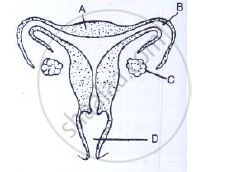
One egg is released from each of the two ovaries every month.
What is fertilization? Name the site of fertilization in the human females.
Give Reasons
Gametes have a haploid (n) number of chromosomes.
Complete the following sentences with appropriate word:
Fertilization of the human egg by the sperm normally occurs in the_______
Multiple Choice Question:
Fertilization means:
What would be the effect if meiosis did not occur in nature?
How many hours are required for the process of capacitation?
State whether True or False:
The chromosome number in germ cells producing the gametes are diploid.
In which part of the human female reproductive system do the following events take place?
Fertilization
What are autosomes chromosomes?
Give any four significances of fertilization in humans.
Which hormones are called neurohypophyseal hormones?
Name the three main regions of the human sperm, and briefly mention the function of each.
Write the specific location of the following:
Acrosome
What are the two sequential blocks that prevent polyspermy?
What is the term used to describe the fusion product of male and female pronuclei?
