Advertisements
Advertisements
प्रश्न
Answer the following question.
What is capacitation? Give its importance.
Advertisements
उत्तर
Capacitation generally requires 5-6 hours during which the acrosome membrane becomes thin, Ca++ enters the sperm, and sperm tails begin to show rapid whiplash movements.
As a result of capacitation, sperms become extra active and begin to start moving upwards from the vagina to the uterus and to the oviducts. Prostaglandins activate the sperms. The vestibular secretions of the female also enhance sperm's motility. The sperms swim at an average speed of 1.5 to 3.0 mm/min and reach the ampulla. The contraction of uterus and fallopian tubes stimulated by oxytocin of females also aids in the movement of sperm. After capacitation the sperms may reach the ampulla within 5 minutes.
APPEARS IN
संबंधित प्रश्न
Differentiate between the following pair:
Efferent duct and sperm duct
State whether the following statement is true or false:
Gestation in humans is completed in about 380 days.
The diagram given below is that of a developing human foetus in the womb. Study the same and answer the question that follow:
How many days does the foetus take to be fully developed?

The figure given below represents the female reproductive system of a mammal.
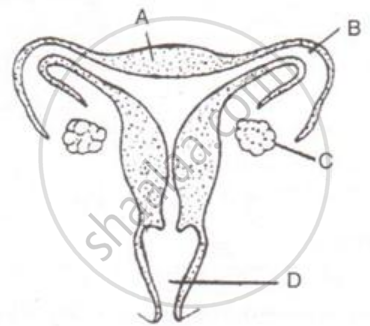
What will happen if the part B on both sides gets blocked?
Write in sequence the regions in which a mature sperm travels from the seminiferous tubules up to the urethral opening?
Name two essential structures which take part in fertilization.
Give Reasons
A large number of sperms are required for fertilizing one egg.
Give a labeled structure of ovum.
Mention, if the following statement is True or False. If false rewrite the wrong statement in its correct form:
Sperm is a highly motile male gamete.
Describe the process of fertilization.
Identify the function of fertilization membrane.
Sperms undergo the following changes in the epididymis EXCEPT ______
What are autosomes chromosomes?
Name the parts of fallopian tubes.
Fertilization takes place in ______.
What are the potential drawbacks in adoption of the IVF method?
- High fatality risk to mother.
- Expensive instruments and reagents.
- Husband/wife necessary for being donors.
- Less adoption of orphans.
- Not available in India.
- Possibility that the early embryo does not survive.
Choose the correct answer from the options given below:
On which day of the menstrual cycle does ovulation typically occur?
What percentage of sperm are demobilized or destroyed in the vagina during capacitation?
Which enzyme digests a localized hole in the zona pellucida to allow sperm entry?
