Advertisements
Advertisements
प्रश्न
Answer the following question.
What is capacitation? Give its importance.
Advertisements
उत्तर
Capacitation generally requires 5-6 hours during which the acrosome membrane becomes thin, Ca++ enters the sperm, and sperm tails begin to show rapid whiplash movements.
As a result of capacitation, sperms become extra active and begin to start moving upwards from the vagina to the uterus and to the oviducts. Prostaglandins activate the sperms. The vestibular secretions of the female also enhance sperm's motility. The sperms swim at an average speed of 1.5 to 3.0 mm/min and reach the ampulla. The contraction of uterus and fallopian tubes stimulated by oxytocin of females also aids in the movement of sperm. After capacitation the sperms may reach the ampulla within 5 minutes.
APPEARS IN
संबंधित प्रश्न
Give the significance of fertilization.
Choose the odd one in each of the following:
Sperm; implantation; fertilization; ovum; afterbirth
State whether the following statement is true or false:
Gestation in humans is completed in about 380 days.
Give appropriate term of the following:
The attachment of developing zygote (blastocyst) on the uterine wall.
The following diagram represents the vertical sectional view of the human female reproductive system.
How does the uterus prepare for the reception of zygote?

The diagram given below is that of a developing human foetus in the womb. Study the same and answer the question that follow:
What term is given to the period of development of the foetus in the womb?
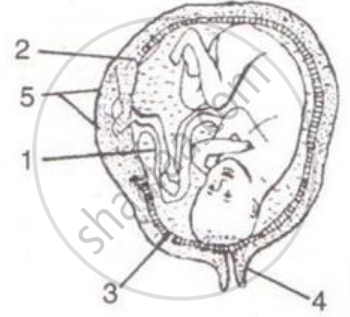
The diagram given below is that of a developing human foetus in the womb. Study the same and answer the question that follow:
How many days does the foetus take to be fully developed?

Write in sequence the regions in which a mature sperm travels from the seminiferous tubules up to the urethral opening?
Where does fertilization occur?
Give Reasons
A large number of sperms are required for fertilizing one egg.
Explain the Term Vas deferens.
Give Technical Term:
How much semen is discharged per ejaculation in a man?
Mention, if the following statement is True or False. If false rewrite the wrong statement in its correct form:
The process of fusion of the sperm nucleus and the egg nucleus is termed implantation.
Multiple Choice Question:
Fertilization means:
Describe the process of fertilization.
State whether the following statement is True or False. If false, correct the statement:
Human egg has a head, middle piece and tail.
Fertilization takes place in ______.
How long after ovulation can the ovum be fertilized?
What role do secretions of the female genital tract play in capacitation?
Which structure sweeps the ovum into the fallopian tube after ovulation?
