Advertisements
Advertisements
प्रश्न
Write a short note on fallopian tube.
Advertisements
उत्तर
Fallopian tubes:
These are a pair of muscular ducts lying horizontally over the peritoneal cavity. The proximal part of the tube lies close to the ovary and distally it opens into the uterus. Each tube is 10 to 12 cm in length. It is internally lined by ciliated epithelium.
It can be divided into three regions:
- Infundibulum:
The proximal funnel-like part with an opening called ostium surrounded by many finger-like processes called fimbriae (of these at least one is long and connected to the ovary). The cilia and the movement of fimbriae help in transporting the ovulated egg to the ostium. - Ampulla:
It is the middle, long and straight part of the oviduct. Fertilization of the ovum takes place in this region. - Isthmus/Cornua:
The distal narrow part of the duct opening into the uterus. - Functions:
- Fallopian tubes carry the released egg from the ovary to the uterus.
- Ampulla provides the site for fertilization of the ovum.
APPEARS IN
संबंधित प्रश्न
Name the following:
The fully developed part of the ovary containing a mature egg.
One egg is released from each of the two ovaries every month.
Complete the following statement by choosing the correct alternative:
Fertilization occurs in ______.
The diagram given below is that of a developing human foetus in the womb. Study the same and answer the question that follow:
How many days does the foetus take to be fully developed?

How is the fetus protected?
Differentiate between tubectomy and vasectomy.
Study the diagram given below and then answer the questions that follow:
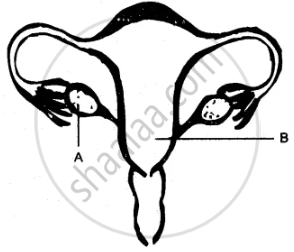
(i) Name the part labeled A. Name any two hormones produced by the part labeled A.
(ii) What happens to the part labeled B.
(1) if fertilization takes place?
(2) If fertilization does not take place?
(iii) Where does fertilization occur?
(iv) Draw a neat diagram of the human sperm as seen under high magnification and label the following parts.
(1) Acrosome
(2) Mitochondria
Complete the following sentences with appropriate word:
The sperms in a human male are produced in _____.
Complete the following sentences with appropriate word:
The process of releasing an egg from the ovary is called _________.
Complete the following sentences with appropriate word:
One egg is normally released from the ovary in the human females after
__________
Define.
Fertilization
Which of the following occurs due to the process of capacitation?
Fertilization of the ovum generally takes place in the ______.
Fertilization takes place in ______.
Which ions enter the sperm during capacitation, causing rapid whiplash movements of the tail?
What structure forms on the egg membrane at the site of sperm contact during fertilization?
What is karyogamy, also known as amphimixis?
Which structure sweeps the ovum into the fallopian tube after ovulation?
How are ova classified in terms of yolk content?
