Advertisements
Advertisements
प्रश्न
Write a short note on fallopian tube.
Advertisements
उत्तर
Fallopian tubes:
These are a pair of muscular ducts lying horizontally over the peritoneal cavity. The proximal part of the tube lies close to the ovary and distally it opens into the uterus. Each tube is 10 to 12 cm in length. It is internally lined by ciliated epithelium.
It can be divided into three regions:
- Infundibulum:
The proximal funnel-like part with an opening called ostium surrounded by many finger-like processes called fimbriae (of these at least one is long and connected to the ovary). The cilia and the movement of fimbriae help in transporting the ovulated egg to the ostium. - Ampulla:
It is the middle, long and straight part of the oviduct. Fertilization of the ovum takes place in this region. - Isthmus/Cornua:
The distal narrow part of the duct opening into the uterus. - Functions:
- Fallopian tubes carry the released egg from the ovary to the uterus.
- Ampulla provides the site for fertilization of the ovum.
APPEARS IN
संबंधित प्रश्न
The middle piece of sperm provides:
Rewrite the terms in the correct order so as to be in a logical sequence.
coitus, ovum, Sperm, sperm duct, urethra, Vagina.
Rewrite the correct statement by changing the last one word if these statement is false.
Pregnancy in women can be prevented by the method of vasectomy.
The diagram given below is that of a developing human foetus in the womb. Study the same and answer the question that follow:
What term is given to the period of development of the foetus in the womb?
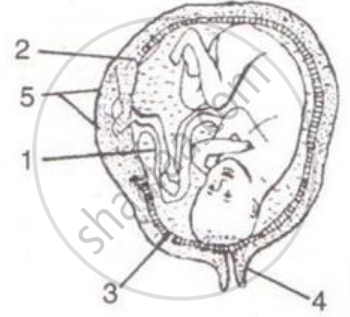
Write in sequence the regions in which a mature sperm travels from the seminiferous tubules up to the urethral opening?
Give Reasons
Gametes have a haploid (n) number of chromosomes.
Differentiate
External fertilization and Internal fertilization.
Differentiate
Isogametes and Heterogametes.
Explain the term Cowper’s glands.
Give Technical Term:
What term is used for the production and maturation of sperms in the testes?
Give Technical Term:
Rupture of the follicle and release of the ovum from the ovary.
Give Technical Term:
A method of contraception in which the sperm duct is cut and ligated.
Mention, if the following statement is True or False. If false rewrite the wrong statement in its correct form:
Sperm is a single cell.
Write the functional activity of the following structure:
Seminal vesicles
Multiple Choice Question:
Fertilization means:
Explain the mechanism of fertilization in humans.
Give scientific reason.
The new individual produced by sexual reproduction always has the recombined genes of both the parents.
The enzyme involved in penetration of sperm into ovum is ______.
State whether the following statement is True or False. If false, correct the statement:
External fertilisation can occur both in water and on land.
What are the potential drawbacks in adoption of the IVF method?
- High fatality risk to mother.
- Expensive instruments and reagents.
- Husband/wife necessary for being donors.
- Less adoption of orphans.
- Not available in India.
- Possibility that the early embryo does not survive.
Choose the correct answer from the options given below:
