Advertisements
Advertisements
Question
What would be the effect if meiosis did not occur in nature?
Advertisements
Solution
- During meiosis, reduction division produces four haploid cells (gametes i.e. human sperm cell and egg cell) from a single diploid cell. Hence, if meiosis does not occur, it will result in a doubling of chromosomes in each successive generation, which will result in the formation of abnormalities.
- If meiosis does not occur, the chromosome number of parents and their offsprings will differ in every generation, hence no species will hold its characters.
- Also, there will be no crossing over of homologous chromosomes. Thus, there will be no variations with respect to the changing environment in progeny to maintain their existence, which may lead to the extinction of species.
APPEARS IN
RELATED QUESTIONS
Define the Zygote.
Name the following:
The part where the sperms are produced in the testes
Differentiate between the following pair:
Efferent duct and sperm duct
Suppose a normal woman has never borne a child; How many mature eggs would she have produced in her lifetime? Your calculation should be based on two clues-
(a) Eggs are produced at the rate of 1 egg every 28 days (one menstrual cycle)
(b) A woman’s total reproductive period is 13 – 45 years.
State whether the following statement is true or false:
Gestation in humans is completed in about 380 days.
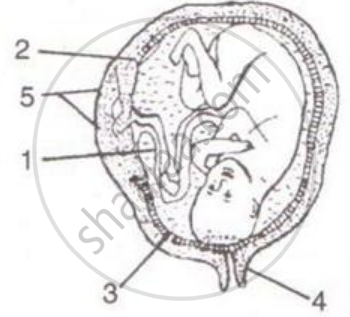
The diagram given below is that of a developing human foetus in the womb. Study the same and answer the question that follow:
Mention two functions of the parts labelled '2' other than its endocrine functions.
The figure given below represents the female reproductive system of a mammal.
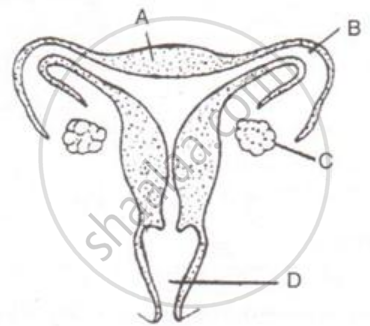
What will happen if the part B on both sides gets blocked?
Where does fertilization occur?
How is the fetus protected?
Give Reasons
Gametes have a haploid (n) number of chromosomes.
Differentiate
External fertilization and Internal fertilization.
Give Technical Term:
In how many weeks fetus development is completed?
Complete the following sentences with appropriate word:
One egg is normally released from the ovary in the human females after
__________
Write the functional activity of the following structure:
Seminal vesicles
State whether True or False:
The chromosome number in germ cells producing the gametes are diploid.
Fertilization takes place in ______.
Choose the odd one out from the group of terms given below and write the category for the remaining terms:
Which enzyme digests a localized hole in the zona pellucida to allow sperm entry?
What is the diameter of the human ovum?
