Advertisements
Advertisements
प्रश्न
What would be the effect if meiosis did not occur in nature?
Advertisements
उत्तर
- During meiosis, reduction division produces four haploid cells (gametes i.e. human sperm cell and egg cell) from a single diploid cell. Hence, if meiosis does not occur, it will result in a doubling of chromosomes in each successive generation, which will result in the formation of abnormalities.
- If meiosis does not occur, the chromosome number of parents and their offsprings will differ in every generation, hence no species will hold its characters.
- Also, there will be no crossing over of homologous chromosomes. Thus, there will be no variations with respect to the changing environment in progeny to maintain their existence, which may lead to the extinction of species.
APPEARS IN
संबंधित प्रश्न
Give the significance of fertilization.
Define the Zygote.
Mention the function of Seeds.
Name the following:
Virgin birth
Give the functions of the following:
Fallopian tube
The figure given below represents the female reproductive system of a mammal.
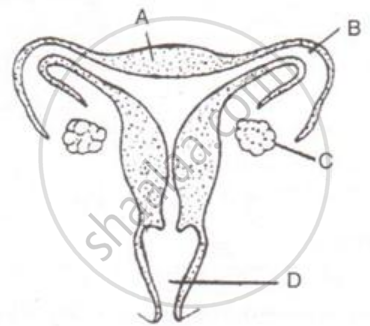
What will happen if the part B on both sides gets blocked?
What are the functions of testes?
Give Reasons
Millions of sperms are produced at ejaculation yet one sperm actually fertilizes the ovum. Explain.
Differentiate
External fertilization and Internal fertilization.
Differentiate between tubectomy and vasectomy.
Name the Following
The basic unit of the testes.
Write the functional activity of the following structure:
Prostate gland
Multiple Choice Question:
Fertilization means:
Give scientific reason.
The new individual produced by sexual reproduction always has the recombined genes of both the parents.
State whether the following statement is True or False. If false, correct the statement:
External fertilisation can occur both in water and on land.
In which part of the human female reproductive system do the following events take place?
Fertilization
What is the meiotic stage of the ovum at the time of ovulation?
Which substance is located on the surface layer of the egg and acts to attract compatible sperm?
What structures surround the ovum and aid in its protection and fertilization?
