Advertisements
Advertisements
प्रश्न
Give scientific reason.
The new individual produced by sexual reproduction always has the recombined genes of both the parents.
Advertisements
उत्तर
- Sexual reproduction involves two parents i.e. male parent and female parent.
- The male gamete coming from a male parent fuses with a female gamete of a female parent to form a zygote which develops into an embryo and then into a new individual.
Thus, the new individual always has the recombined genes of both the parents.
संबंधित प्रश्न
Name the following:
The part where the sperms are produced in the testes
Name the following:
The accessory gland in human males whose secretion activates the sperms
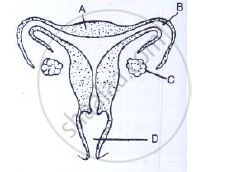
The figure given alongside represents the female reproductive system of a mammal.
Name the parts labelled A - D
State whether the following statement is true or false:
Gestation in humans is completed in about 380 days.
Choose the correct answer:
Virgin birth is called ______________
The following diagram represents the vertical sectional view of the human female reproductive system.
How does the uterus prepare for the reception of zygote?

What are the functions of testes?
Give Reasons
The oviduct funnel is lined with cilia.
Differentiate
Isogametes and Heterogametes.
Give Technical Term:
How much semen is discharged per ejaculation in a man?
Give Technical Term:
What term is used for the production and maturation of sperms in the testes?
Complete the following sentences with appropriate word:
Fertilization of the human egg by the sperm normally occurs in the_______
Mention, if the following statement is True or False. If false rewrite the wrong statement in its correct form:
Sperm is a single cell.
Mention, if the following statement is True or False. If false rewrite the wrong statement in its correct form:
The process of fusion of the sperm nucleus and the egg nucleus is termed implantation.
Write a short note on fallopian tube.
What is sex chromosomes?
Fertilization takes place in ______.
During copulation, approximately how much semen containing how many spermatozoa is deposited in the vagina?
What is the meiotic stage of the ovum at the time of ovulation?
