Advertisements
Advertisements
Question
Give any four significances of fertilization in humans.
Advertisements
Solution
- The secondary oocyte completes the process of oogenesis and is transformed into a mature ovum (n).
- The diploid chromosome number is restored in the zygote by the process of syngamy.
- The ovum lacks the centrioles necessary for further divisions, which are received from the sperm during fertilization.
- Fertilization involves the fusion of male and female gametes from the two parents. It results in variations that are significant to evolution.
- The sex of the offspring is determined.
Notes
Students should refer to the answer according to their question.
APPEARS IN
RELATED QUESTIONS
Give the significance of fertilization.
Name the following:
The accessory gland in human males whose secretion activates the sperms
Name the following:
Fusion of sperm and ovum.
Complete the following statement by choosing the correct alternative:
Fertilization occurs in ______.
Define the following:
Spermatogenesis
The diagram given below is that of a developing human foetus in the womb. Study the same and answer the question that follow:
Mention two functions of the parts labelled '2' other than its endocrine functions.
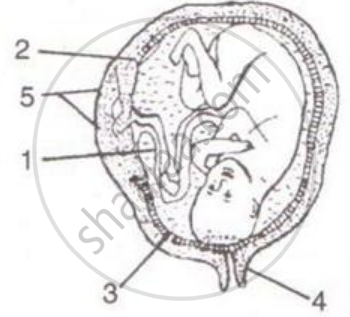
Write in sequence the regions in which a mature sperm travels from the seminiferous tubules up to the urethral opening?
What is fertilization? Name the site of fertilization in the human females.
Mention, if the following statement is True or False. If false rewrite the wrong statement in its correct form:
Vas deferens transports sperms into the urethra.
Mention, if the following statement is True or False. If false rewrite the wrong statement in its correct form:
Fertilization is the product of the egg nucleus and the sperm nucleus.
Multiple Choice Question:
Fertilization means:
What is fertilization?
Explain tubectomy and vasectomy.
Match the pair:
| 'A' | 'B' | ||
| (1) | Male | (a) | 44 + XX |
| (b) | 44 + XY | ||
| (c) | 44 + YY |
Match the items in column I with those in column II and write down the matching pairs (some may not match).
| Column I | Column II | ||
| (a) | Acrosome | (i) | An embryo which looks like human baby. |
| (b) | Gestation | (ii) | Luteinizing hormone |
| (c) | Menopause | (iii) | Ovum producing cells. |
| (d) | Foetus | (iv) | Semen |
| (e) | Oogenesis | (v) | Spermatozoa |
| (f) | Ovulation | (vi) | Complete stoppage of menstrual cycle. |
| (vii) | Time taken by a fertilised egg till the delivery of baby. |
Write the specific location of the following:
Acrosome
How long after ovulation can the ovum be fertilized?
What is the location and nature of antifertilizin?
What structure forms on the egg membrane at the site of sperm contact during fertilization?
