Advertisements
Advertisements
प्रश्न
Give any four significances of fertilization in humans.
Advertisements
उत्तर
- The secondary oocyte completes the process of oogenesis and is transformed into a mature ovum (n).
- The diploid chromosome number is restored in the zygote by the process of syngamy.
- The ovum lacks the centrioles necessary for further divisions, which are received from the sperm during fertilization.
- Fertilization involves the fusion of male and female gametes from the two parents. It results in variations that are significant to evolution.
- The sex of the offspring is determined.
Notes
Students should refer to the answer according to their question.
APPEARS IN
संबंधित प्रश्न
When pregnancy does not occur, the life of corpus luteum is about ______.
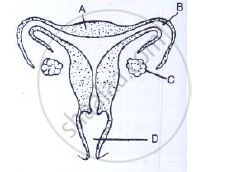
The figure given alongside represents the female reproductive system of a mammal.
Name the parts labelled A - D
State whether the following statement is true or false:
Gestation in humans is completed in about 380 days.
Name the following:
Organ where fertilization occurs.
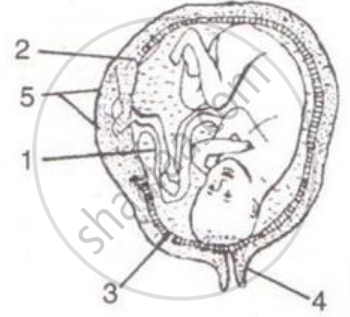
The diagram given below is that of a developing human foetus in the womb. Study the same and answer the question that follow:
What term is given to the period of development of the foetus in the womb?
What are the functions of testes?
Give Reasons
Gametes have a haploid (n) number of chromosomes.
Give Reasons
The urethra is also called urinogenital duct.
Complete the following sentences with appropriate word:
___________ hormones are secreted by the interstitial cells.
Multiple choice question.
In human female, the fertilized egg gets implanted in uterus _______.
How can plants and animals save themselves from extinction?
Explain the process of fertilization.
The eggs of frogs do not have shells for protection, yet they are safe in water, how?
State whether the following statement is True or False. If false, correct the statement:
External fertilisation can occur both in water and on land.
Name the parts of fallopian tubes.
Write the specific location of the following:
Acrosome
At which anatomical location does fertilization occur in humans?
What is the meiotic stage of the ovum at the time of ovulation?
What is the result of sperm entry into the secondary oocyte?
What structures surround the ovum and aid in its protection and fertilization?
