Advertisements
Advertisements
Question
An unknown alcohol is treated with Lucas reagent. Explain how you will determine whether the alcohol is primary, secondary or tertiary. Indicate by chemical equation the reaction between isopropyl alcohol and Lucas reagent.
Advertisements
Solution
Primary, secondary and tertiary alcohols can be distinguished from each other in the laboratory using Lucas reagent (conc. HCl and ZnCl2).
- An unknown alcohol is treated with Lucas reagent.
The reaction involved is: \[\ce{R - OH ->[HCl][ZnCl2] R - Cl}\] - Depending on the observation an unknown alcohol can be identified as primary, secondary or tertiary.
Test Observation Inference Unknown Alcohol + Lucas reagent Reagent turns turbid on heating. Primary alcohol is present. Unknown Alcohol + Lucas reagent Reagent turns turbid slowly, without heating. Secondary alcohol is present. Unknown Alcohol + Lucas reagent Reagent turns turbid immediately, without heating. Tertiary alcohol is present. - The reaction between isopropyl alcohol and Lucas reagent can be given as:
\[\begin{array}{cc}
\ce{CH3 - CH - CH3 + HCl + ZnCl2 -> CH3 - CH - CH3}\\
\phantom{..}|\phantom{......................................}|\phantom{..}\\
\phantom{.....}\ce{\underset{\text{Isopropyl alcohol (2° alcohol)}}{OH} \phantom{....................}\underset{\text{Isopropyl chloride}}{Cl}}\phantom{........}
\end{array}\]
The reagent will turns turbid slowly, without heating.
APPEARS IN
RELATED QUESTIONS
Answer in one sentence/ word.
Hydroboration-oxidation of propene gives _________.
Answer in brief.
Explain why phenol is more acidic than ethyl alcohol.
Answer in brief.
Give a simple chemical test to distinguish between ethanol and ethyl bromide.
Reaction between Grignard reagent and aldehyde other than formaldehyde leads to formation of _______________
When vapours of tert.butyl alcohol are passed over hot copper, it gives _____________
Reaction between hot conc. HI and anisole gives ______________
Write the reaction to get aspirin from salicylic acid.
Draw intramolecular hydrogen bonding structure in o-nitrophenol.
Write chemical reactions to convert phenol into salicyaldehyde. Write the name of the reaction. What happens when if CCl4 is used instead of CHCl3 in the above reaction.
Which of the following compounds is obtained, when phenol react with bromine water?
Phenol is obtained from cumene ____________.
What is the product of the following reaction?
\[\ce{CH3 - CH2 - CH2 - OH ->[conc. H2SO4][\Delta]}\]
Identify 'A' and 'B' in the following series of reactions.
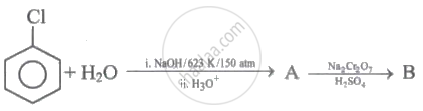
\[\ce{CH3 - CH = CH2 ->[HBr][Peroxide] A}\]
Identify A.
The product 'C' in the following reaction is:
\[\ce{CH3CH2Br ->[alc. KCN] {'A'} ->[H3O^+][\Delta] {'B'} ->[i. LiAlH4][ii. H3O^+] {'C'}}\]
Carbolic acid is oxidised by acidified sodium dichromate to give ______.
Which of the following is INCORRECT regarding phenol?
Which of the following reagents is used to convert phenol to benzene?
Which of the following conversion explains the acidic nature of alcohols?
The number of σ bonds in carbolic acid is ______.
Identify the compound having highest boiling point from the following?

Product (B) in this reaction is:
Amongst the following alcohols which would react fastest with cone. HCl and ZnCl2?
Explain the reaction of 1° and 2° alcohol with oxidising agent chromic anhydride (CrO3).
Write the product when 1°, 2° and 3° alcohol vapours are passed over hot copper.
Write the chemical reaction when hot copper is treated with Vapours of 1° (primary) alcohol.
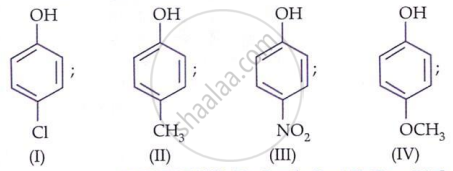
Arrange the following compounds in order of decreasing acidity: