Advertisements
Advertisements
प्रश्न
An unknown alcohol is treated with Lucas reagent. Explain how you will determine whether the alcohol is primary, secondary or tertiary. Indicate by chemical equation the reaction between isopropyl alcohol and Lucas reagent.
Advertisements
उत्तर
Primary, secondary and tertiary alcohols can be distinguished from each other in the laboratory using Lucas reagent (conc. HCl and ZnCl2).
- An unknown alcohol is treated with Lucas reagent.
The reaction involved is: \[\ce{R - OH ->[HCl][ZnCl2] R - Cl}\] - Depending on the observation an unknown alcohol can be identified as primary, secondary or tertiary.
Test Observation Inference Unknown Alcohol + Lucas reagent Reagent turns turbid on heating. Primary alcohol is present. Unknown Alcohol + Lucas reagent Reagent turns turbid slowly, without heating. Secondary alcohol is present. Unknown Alcohol + Lucas reagent Reagent turns turbid immediately, without heating. Tertiary alcohol is present. - The reaction between isopropyl alcohol and Lucas reagent can be given as:
\[\begin{array}{cc}
\ce{CH3 - CH - CH3 + HCl + ZnCl2 -> CH3 - CH - CH3}\\
\phantom{..}|\phantom{......................................}|\phantom{..}\\
\phantom{.....}\ce{\underset{\text{Isopropyl alcohol (2° alcohol)}}{OH} \phantom{....................}\underset{\text{Isopropyl chloride}}{Cl}}\phantom{........}
\end{array}\]
The reagent will turns turbid slowly, without heating.
APPEARS IN
संबंधित प्रश्न
Answer in one sentence/ word.
Write the IUPAC name of alcohol having molecular formula C4H10O which is resistant towards oxidation.
Answer in brief.
Give the equations of the reactions for the preparation of phenol from isopropyl benezene.
An ether (A), C5H12O, when heated with excess of hot HI produce two alkyl halides which on hydrolysis form compound (B) and (C), oxidation of (B) gave and acid (D), whereas oxidation of (C) gave a ketone (E). Deduce the structural formula of (A), (B), (C), (D), and (E).
Oxidation of ethyl alcohol using K2Cr2O7/dil H2SO4 leads to formation of _______________
When vapours of tert.butyl alcohol are passed over hot copper, it gives _____________
Reaction between hot conc. HI and anisole gives ______________
Write Kolbe’s reaction.
What is the action of following on phenol at low temperature?
- dil. HNO3
- conc. H2SO4
- Br2/CS2
How will you bring about the following conversions?
2-methyl propan-2-ol to 2-methylpropene
Number of oxygen atoms present in salicylaldehyde are ______.
Which alcohol is difficult to oxidise?
In the Lucas test for alcohols, the appearance of turbidity is due to the formation of ____________.
Phenol is obtained from cumene ____________.
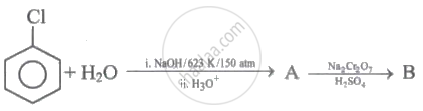
Identify 'A' and 'B' in the following series of reactions.
\[\ce{CH3 - CH = CH2 ->[HBr][Peroxide] A}\]
Identify A.
Sodium benzene sulphonate reacts with NaOH and then on acidic hydrolysis, it gives __________.
The number of σ bonds in carbolic acid is ______.
Which of the following on oxidation yields ethyl methyl ketone?
Identify the alcohol that reacts immediately with Lucas reagent?
Identify the compound having highest boiling point from the following?
Identify the compound amongst the following of which 0.1 M aqueous solution has highest boiling point.
The acid, which contains both -OH and -COOR groups is ______.
Which of the following compounds has lowest boiling point?
Which among the following is not the method of preparation of phenol?
The product C in the following reaction is

Write the chemical reaction when hot copper is treated with Vapours of 1° (primary) alcohol.
Explain: Phenols are acid while alcohol is neutral.
What is the name of isopropyl alcohol according to the carbinol system?
