Advertisements
Advertisements
प्रश्न
An unknown alcohol is treated with Lucas reagent. Explain how you will determine whether the alcohol is primary, secondary or tertiary. Indicate by chemical equation the reaction between isopropyl alcohol and Lucas reagent.
Advertisements
उत्तर
Primary, secondary and tertiary alcohols can be distinguished from each other in the laboratory using Lucas reagent (conc. HCl and ZnCl2).
- An unknown alcohol is treated with Lucas reagent.
The reaction involved is: \[\ce{R - OH ->[HCl][ZnCl2] R - Cl}\] - Depending on the observation an unknown alcohol can be identified as primary, secondary or tertiary.
Test Observation Inference Unknown Alcohol + Lucas reagent Reagent turns turbid on heating. Primary alcohol is present. Unknown Alcohol + Lucas reagent Reagent turns turbid slowly, without heating. Secondary alcohol is present. Unknown Alcohol + Lucas reagent Reagent turns turbid immediately, without heating. Tertiary alcohol is present. - The reaction between isopropyl alcohol and Lucas reagent can be given as:
\[\begin{array}{cc}
\ce{CH3 - CH - CH3 + HCl + ZnCl2 -> CH3 - CH - CH3}\\
\phantom{..}|\phantom{......................................}|\phantom{..}\\
\phantom{.....}\ce{\underset{\text{Isopropyl alcohol (2° alcohol)}}{OH} \phantom{....................}\underset{\text{Isopropyl chloride}}{Cl}}\phantom{........}
\end{array}\]
The reagent will turns turbid slowly, without heating.
APPEARS IN
संबंधित प्रश्न
Answer in one sentence/ word.
Write the IUPAC name of alcohol having molecular formula C4H10O which is resistant towards oxidation.
Answer in one sentence/ word.
Write the name of the electrophile used in Kolbe’s Reaction.
Answer in brief.
Give a simple chemical test to distinguish between ethanol and ethyl bromide.
Write IUPAC name of crotonyl alcohol.
Write the reaction to get aspirin from salicylic acid.
Write the reaction involved in the preparation of phenol from benzene sulphonic acid.
Write chemical equation of acetyl chloride with phenol
How will you bring about the following conversions?
acetone to 2-methylpropan-2-ol
What is the action of conc. H2SO4 on carbolic acid at 373 K.
Phenol reacts with concentrated nitric acid in the presence of cone. H2SO4 to form ____________.
Which of the following reagents are required in the conversion of phenol to salicylic acid?
Propane when treated with cold cone. H2SO4 forms a compound which on heating with water gives ______.
Identify 'A' and 'B' in the following series of reactions.
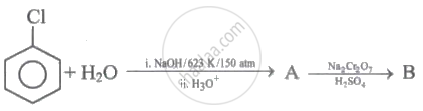
\[\ce{CH3 - CH = CH2 ->[HBr][Peroxide] A}\]
Identify A.
In Dow process, chlorobenzene is converted into phenol by ____________.
+I effect of alkyl groups in alcohols increases the stability of ____________.
Phenoxide ion is more stable than phenol due to the ____________.

Identify reagents X, Y and Z.
What is INCORRECT about the product written in the below given reaction?
\[\ce{R - CH2 - OH ->[PCC] R - COOH}\]
Which among the following is allylic secondary alcohol?
Name the catalyst used in commercial method of preparation of phenol.
The product C in the following reaction is

The major product obtained in the following reaction is

Arrange O - H, C - H and N - H bonds in increasing order of their bond polarity.
Write the chemical reaction when hot copper is treated with Vapours of 1° (primary) alcohol.
Write chemical reaction when hot copper is treated with Vapours of 3° (tertiary) alcohol.
Propene can be converted into propan-1-ol by:
