Advertisements
Advertisements
Question
A ray of light is incident normally on a plane mirror. What will be the
angle of incidence?
Advertisements
Solution
The angle of incidence is 0o because the incident ray is parallel to the normal.
APPEARS IN
RELATED QUESTIONS
An image that cannot be obtained on a screen is called ______.
Name the two types of spherical mirrors. What type of mirror is represented by the:
front side of a shining steel spoon?
A 50 cm tall object is at a very large distance from a diverging lens. A virtual, erect and diminished image of the object is formed at a distance of 20 cm in front of the lens. How much is the focal length of the lens?
A ray of light travels from a denser medium to a rarer medium. How will it bend?
How is a spherical mirror used to converge a beam of light at a point? Name the type of mirror used.
State the direction of incident ray which after reflection from a spherical mirror gets reflected along its own path. Give a reason.
Which are the two convenient rays that are chosen to construct the image by a spherical mirror for a given object? Explain with the help of suitable ray diagrams.
State the kind of mirror used
(a) by a dentist, and
(b) as a street light reflector.
Define the terms pole, principal axis and centre of curvature with reference to a spherical mirror.
Does the mirror mentioned in part (b) form real image for all locations of the object?
Name the kind of mirror used to obtain:
A virtual and diminished image
Upto what maximum distance from the pole the image in a convex mirror can be obtained? what will be the location of object then ?
For an incident ray directed towards centre of curvature of a spherical mirror the reflected ray:
The magnification for a mirror is -3. How are u and v related?
An object 5 cm high is placed at a distance 60 cm in front of a concave mirror of focal length 10 cm. Find the position and size of the image.
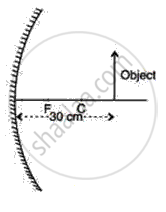
An object is placed in front of a concave mirror as shown in the following figure. By scale drawing, find the nature of the image. Given f = 10 cm, v = 30 cm.
The diagram below shows the parallel rays incident on a convex mirror. C is the centre of the curvature of the mirror. By drawing the paths of the reflected rays, label the focus F and hence find the focal length of the mirror.
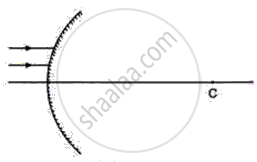
Complete the following diagrams shown in the following figures by drawing the reflected rays.
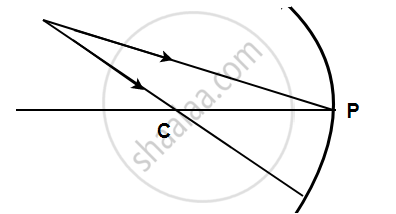
Explain why a ray of light passing through the center of curvature of a concave mirror, gets reflected along with the same pattern.
