Advertisements
Advertisements
Question
A Project has the following time schedule
| Activity | 1 - 2 | 2 - 3 | 2 - 4 | 3 - 5 | 4 - 6 | 5 - 6 |
| Duration (in days) |
6 | 8 | 4 | 9 | 2 | 7 |
Draw the network for the project, calculate the earliest start time, earliest finish time, latest start time and latest finish time of each activity and find the critical path. Compute the project duration.
Advertisements
Solution

E1 = 0
E2 = 0 + 6 = 6
E3 = 6 + 8 = 14
E4 = 6 + 4 = 10
E5 = 14 + 9 = 23
E6 = (23 + 7) or (10 + 2)
Whichever is maximum
= 30
L6 = 30
L5 = 30 − 6 = 24
L4 = 30 − 2 = 28
L3 = 23 − 9 = 14
L2 = (14 − 8) or (28 − 4)
Whichever is minimum
= 6
L1 = 6 − 6 = 0
| Activity | Duration tij |
EST | EFT = EST + tij | LST = LFT – tij | LFT |
| 1 - 2 | 6 | 0 | 6 | 6 − 6 = 0 | 6 |
| 2 - 3 | 8 | 6 | 14 | 14 − 8 = 6 | 14 |
| 2 - 4 | 4 | 6 | 10 | 28 − 4 = 24 | 28 |
| 3 - 5 | 9 | 14 | 23 | 23 − 9 = 14 | 23 |
| 4 - 6 | 2 | 10 | 22 | 30 − 28 = 2 | 4 |
| 5 - 6 | 7 | 23 | 30 | 30 − 7 = 23 | 30 |
Since EFT and LFT values are same in 1 - 2, 2 - 3, 3 - 5 and 5 - 6.
Hence the critical path is 1 - 2 - 3 - 5 - 6 and the duration of time taken is 30 days.
APPEARS IN
RELATED QUESTIONS
Construct the network for the projects consisting of various activities and their precedence relationships are as given below:
A, B, C can start simultaneously A < F, E; B < D, C; E, D < G
Construct the network for each the projects consisting of various activities and their precedence relationships are as given below:
| Activity | A | B | C | D | E | F | G | H | I | J | K |
| Immediate Predecessors | - | - | - | A | B | B | C | D | E | H, I | F, G |
A project schedule has the following characteristics
| Activity | 1 - 2 | 1 - 3 | 2 - 4 | 3 - 4 | 3 - 5 | 4 - 9 | 5 - 6 | 5 - 7 | 6 - 8 | 7 - 8 | 8 - 10 | 9 - 10 |
| Time | 4 | 1 | 1 | 1 | 6 | 5 | 4 | 8 | 1 | 2 | 5 | 7 |
Construct the network and calculate the earliest start time, earliest finish time, latest start time and latest finish time of each activity and determine the Critical path of the project and duration to complete the project.
A Project has the following time schedule
| Activity | 1 - 2 | 1 - 6 | 2 - 3 | 2 - 4 | 3 - 5 | 4 - 5 | 6 - 7 | 5 - 8 | 7 - 8 |
| Duration (in days) | 7 | 6 | 14 | 5 | 11 | 7 | 11 | 4 | 18 |
Construct the network and calculate the earliest start time, earliest finish time, latest start time and latest finish time of each activity and determine the Critical path of the project and duration to complete the project.
The following table use the activities in a construction projects and relevant information
| Activity | 1 - 2 | 1 - 3 | 2 - 3 | 2 - 4 | 3 - 4 | 4 - 5 |
| Duration (in days) |
22 | 27 | 12 | 14 | 6 | 12 |
Draw the network for the project, calculate the earliest start time, earliest finish time, latest start time and latest finish time of each activity and find the critical path. Compute the project duration.
The critical path of the following network is
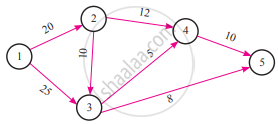
One of the conditions for the activity (i, j) to lie on the critical path is
Which of the following is not correct?
In the context of network, which of the following is not correct
The objective of network analysis is to
