Advertisements
Advertisements
Question
A piece of wood is floating in water kept in a bottle. The bottle is connected to an air pump. Neglect the compressibility of water. When more air is pushed into the bottle from the pump, the piece of wood will float with
Options
larger part in the water
lesser part in the water
same part in the water
it will sink
Advertisements
Solution
same part in the water
When more air is pushed into the bottle from the pump, the pressure of air increases on the wood as well as on the water surface with the same amount. So, the level of water and wood does not change. Thus, the piece of wood floats with the same part in the water.
APPEARS IN
RELATED QUESTIONS
Name two applications of Pascal's law.
Draw a simple diagram of a hydraulic jack and explain its working.
The area of cross-sections of the pump plunger and press plunger of a hydraulic press is 0.02 m2 and 8 m2 respectively. If the hydraulic press overcomes a load of 800 kgf, calculate the force acting on the pump plunger.
If the mechanical advantage of the handle of the pump plunger is 8, calculate the force applied at the end of the handle of the pump plunger.
Select the correct option.
Pressure at a point inside a liquid does not depend on
The atmospheric pressure at a place is 650 mm of Hg. Calculate this pressure in Pascals (Pa).
P is the pressure at some point in a liquid. State whether pressure P is a scalar or vector quantity.
The following figure shows a manometer containing a liquid of density p. The limb P of the manometer is connected to a vessel V and the limb Q is open to atmosphere. The difference in the levels of liquid in the two limbs of the manometer is h as shown in the diagram. The atmospheric pressure is P0.
(i) What is the pressure on the liquid surface in the limb Q?
(ii) What is the pressure on the liquid surface in the limb P?

Name three applications of Pascal's law.
What is the use of altimeter?
What are the factors on which the pressure of a liquid depends?
State two applications of Pascal's law.
Pascal’s law is used in
State Pascal’s law.
Assertion: Pascal’s law is the working principle of a hydraulic lift.
Reason: Pressure is thrust per unit area.
An iceberg of density 700 kg/m3 is floating in the water of density 1000 kg/m3. The percentage of the volume of ice cube outside the water is:
Consider a water tank shown in the figure. It has one wall at x = L and can be taken to be very wide in the z direction. When filled with a liquid of surface tension S and density ρ, the liquid surface makes angle θ(θ << 1) with the x-axis at x = L. If y(x) is the height of the surface then the equation for y(x) is:
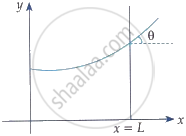
(take θ(x) = sin θ(x) = tan θ(x) = `dy/dx`, g is the acceleration due to gravity)
