Advertisements
Advertisements
Question
The area of cross-sections of the pump plunger and press plunger of a hydraulic press is 0.02 m2 and 8 m2 respectively. If the hydraulic press overcomes a load of 800 kgf, calculate the force acting on the pump plunger.
Advertisements
Solution
Load on the press plunger = L = 800 kgf
Let the effort acting on the pump plunger = E
Area of cross-section of pump plunger = A1 = 0.02 m2
Area of cross-section of press plunger = A2 = 8 m2
Now, `"L"/"E"="A"_2/"A"_1`
`800/"E"=8/0.02=800/2=400`
E = `800/400` = 2kgf
⇒ Force acting on the pump plunger = 2kgf
APPEARS IN
RELATED QUESTIONS
Name two applications of Pascal's law.
Name and state the principle on which a hydraulic press works. Write one use of hydraulic press.
In a hydraulic machine, a force of 2 N is applied on the piston of area of cross section 10 cm2. What force is obtained on its piston of area of cross section 100 cm2 ?
How does the liquid pressure on a diver change according to the following condition:
When the driver moves horizontally
How does the liquid pressure on a diver change according to the following condition:
When the driver moves to the greater depth?
Pascal’s law is used in
State Pascal’s law.
What are Force multipliers?
Consider a water tank shown in the figure. It has one wall at x = L and can be taken to be very wide in the z direction. When filled with a liquid of surface tension S and density ρ, the liquid surface makes angle θ(θ << 1) with the x-axis at x = L. If y(x) is the height of the surface then the equation for y(x) is:
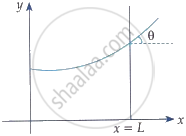
(take θ(x) = sin θ(x) = tan θ(x) = `dy/dx`, g is the acceleration due to gravity)
