Advertisements
Advertisements
प्रश्न
A piece of wood is floating in water kept in a bottle. The bottle is connected to an air pump. Neglect the compressibility of water. When more air is pushed into the bottle from the pump, the piece of wood will float with
पर्याय
larger part in the water
lesser part in the water
same part in the water
it will sink
Advertisements
उत्तर
same part in the water
When more air is pushed into the bottle from the pump, the pressure of air increases on the wood as well as on the water surface with the same amount. So, the level of water and wood does not change. Thus, the piece of wood floats with the same part in the water.
APPEARS IN
संबंधित प्रश्न
Define one pascal (Pa), the S.I. unit of pressure.
Explain the principle of a hydraulic machine. Name two devices which work on this principle.
Name and state the principle on which a hydraulic press works. Write one use of hydraulic press.
What should be the ratio of area of cross section of the master cylinder and wheel cylinder of a hydraulic brake so that a force of 15 N can be obtained at each of its brake shoe by exerting a force of 0.5 N on the pedal ?
66640 Pa pressure is exerted by 0.50 m vertical column of a liquid. If g = 9.8 Nkg−1, calculate the density of the liquid.
The atmospheric pressure at a place is 650 mm of Hg. Calculate this pressure in Pascals (Pa).
Name three applications of Pascal's law.
What are the factors on which the pressure of a liquid depends?
State Pascal's law.
Pascal’s law is used in
State Pascal’s law.
Analogy
Pascal’s law: ______:: Surface tensin: ______.
Match the following:
| 1. | Hydraulic press | a. | Archimedes |
| 2. | Cartesian Diver | b. | Floatation |
| 3. | Hydrostatic Balance | c. | Pascal’s law |
| 4. | Hydrometer | d. | Buoyancy |
Consider a water tank shown in the figure. It has one wall at x = L and can be taken to be very wide in the z direction. When filled with a liquid of surface tension S and density ρ, the liquid surface makes angle θ(θ << 1) with the x-axis at x = L. If y(x) is the height of the surface then the equation for y(x) is:
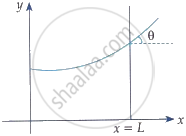
(take θ(x) = sin θ(x) = tan θ(x) = `dy/dx`, g is the acceleration due to gravity)
