Advertisements
Advertisements
Question
A copper vessel of mass 100 g contains 150 g of water at 50°C. How much ice is needed to cool it to 5°C?
Given: Specific heat capacity of copper = 0.4 Jg−1 °C−1
The Specific heat capacity of water = 4.2 Jg−1 °C−1
The Specific latent heat of fusion ice = 336 Jg−1
Advertisements
Solution
Given: Mass of copper vessel, \(m_1=100\,\text{g}\)
Mass of water, \(m_2=150\,\text{g}\)
Initial temperature, \(T_1=50^\circ\text{C}\)
Final temperature, \(T_2=5^\circ\text{C}\)
Specific heat capacity of copper, \(c_1=0.4\,\text{J g}^{-1}\,^\circ\text{C}^{-1}\)
Specific heat capacity of water, \(c_2=4.2\,\text{J g}^{-1}\,^\circ\text{C}^{-1}\)
Specific latent heat of fusion of ice, \(L=336\,\text{J g}^{-1}\)
Assumption: Ice is initially at 0°C, and no heat is lost to the surroundings.
Now, heat energy lost by the copper vessel is:
\[ Q_1=m_1c_1(T_1-T_2) \]
\[ =100\times0.4\times(50-5) \]
\[ =1800\,\text{J} \]
Similarly, heat energy lost by water is:
\[ Q_2=m_2c_2(T_1-T_2) \]
\[ =150\times4.2\times(50-5) \]
\[ =28350\,\text{J} \]
Hence, the total heat energy lost is:
\[ Q=Q_1+Q_2 \]
\[ =1800+28350=30150\,\text{J} \]
Ice at 0°C melts and the resulting water warms to 5°C.
\[ Q=mL+mc_2(5-0) \]
\[ =336m+4.2m\times5 \]
\[ =357m \]
According to the principle of calorimetry,
\[ \text{Heat lost}=\text{Heat gained} \]
\[ 30150=357m \]
\[ m=\frac{30150}{357}\]
\[=84.45\,\text{g} \]
RELATED QUESTIONS
A solid metal weighing 150 g melts at its melting point of 800 °C by providing heat at the rate of 100 W. The time taken for it to completely melt at the same temperature is 4 min. What is the specific latent heat of fusion of the metal?
Heat supplied to a solid change it into liquid. What is this change in the phase called?
It is generally cold after a hail-storm then during and before the hail storm. Give reason.
Explain the meaning of green house effect.
1 kg of water freezes to form ice at 0°C. What amount of heat is withdrawn?
Describe a method to determine the specific heat capacity of a solid (say, a piece of copper).
A substance is in the form of a solid at 0°C. The amount of heat added to this substance and the temperature of the substance are plotted on the following graph:
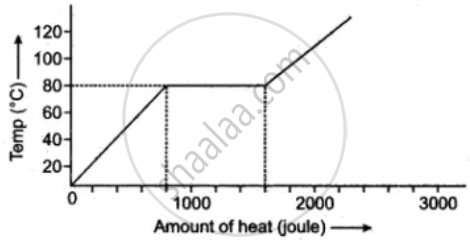
If the specific heat capacity of the solid substance is 500 J/kg °G, find from the graph, the mass of the substance.
Water falls from a height of 50 m. Calculate the rise in the temperature of water when it strikes the bottom.
(g = 10 ms-2; Specific heat capacity of water = 4200 J / kg°C)
Derive Mayer’s relation.
Explain why the specific heat capacity at constant pressure is greater than the specific heat capacity at constant volume.
