Advertisements
Online Mock Tests
Chapters
2: Chemical Bonding
3: Acids, Bases and Salts
▶ 4: Analytical Chemistry
5: Mole concept and Stoichiometry
6: Electrolysis
7: Metallurgy
8: Study of Compounds A. Hydrogen Chloride
9: Study of Compounds B. Ammonia
10: Study of Compounds C. Nitric Acid
11: Study of Compounds D. Sulphuric Acid
12: Organic Chemistry
13: Practical Work

Advertisements
Solutions for Chapter 4: Analytical Chemistry
Below listed, you can find solutions for Chapter 4 of CISCE S.P. Singh for कन्साइस केमिस्ट्री [इंग्रजी] इयत्ता १० आयसीएसई.
S.P. Singh solutions for कन्साइस केमिस्ट्री [इंग्रजी] इयत्ता १० आयसीएसई 4 Analytical Chemistry lntext Questions [Page 70]
What do you understand by the following:
Analysis
What do you understand by the following:
Qualitative analysis
What do you understand by the following:
Reagent
What do you understand by the following:
Precipitation
Write the probable colour of the following salt:
Iron (III) chloride
Write the probable colour of the following salt:
Potassium nitrate
Write the probable colour of the following salt:
Ferrous sulphate
Write the probable colour of the following salt:
Aluminium acetate
Name the probable cation present based on the following observation:
White precipitate insoluble in NH4OH but soluble in NaOH.
Name the probable cation present based on the following observation:
Blue coloured solution.
Name the metal hydroxides which are insoluble in caustic soda solution.
Name the metal hydroxides which are insoluble in ammonium hydroxide solution.
Name the metal hydroxides which are soluble in caustic soda solution.
Name the metal hydroxides which are soluble in ammonium hydroxide solution.
What do you observe when ammonium salt is heated with caustic soda solution?
Write the word equation when ammonium salt is heated with caustic soda solution.
How will you distinguish NH4OH solution from NaOH solution?
Why the alkali is added drop by drop to the salt solution?
Write balanced equation reaction of sodium hydroxide solution with iron (III) chloride solution.
Write balanced equation copper sulphate solution with ammonium hydroxide solution.
S.P. Singh solutions for कन्साइस केमिस्ट्री [इंग्रजी] इयत्ता १० आयसीएसई 4 Analytical Chemistry EXERCISE-4 [Pages 72 - 74]
Colour of an aqueous solution of copper sulphate is ______.
Green
Brown
Blue
Yellow
Colour of the precipitate formed on adding NaOH solution to iron (II) sulphate solution is ______.
White
Brown
Green
Pale blue
A metal which produces hydrogen on reacting with alkali as well as with acid.
Iron
Magnesium
Zinc
Copper
The salt solution which does not react with ammonium hydroxide is ______.
Calcium nitrate
Zinc nitrate
Lead nitrate
Copper nitrate
Which of the following is the best reagent to distinguish between ethylene and acetylene?
P Bromine water
Q Ammoniacal silver nitrate solution
R Acidified potassium dichromate solution
Only P
Only Q
Both P and Q
Both Q and R
A student takes Cu, Al, Fe and Zn strips, separately in four test tubes labeled as I, II, III and IV respectively. He adds 10 ml of freshly prepared ferrous sulphate solution to each test tube and observes the colour of the metal residue in each case.

He would observe a black residue in the test tubes:
(I) and (II)
(I) and (III)
(II) and (III)
(II) and (IV)
The following questions are Assertion-Reason based questions. Choose the answer based on the codes given below.
Assertion (A): Calcium salt solution does not show any change even after adding an excess of ammonia solution to it.
Reason (R): The low concentration of hydroxide ion in ammonium hydroxide solution which are unable to precipitate the hydroxide ions of calcium.
Both A and R are true and R is the correct explanation of A.
Both A and R are true but R is not the correct explanation of A.
A is true but R is false.
A is false but R is true.
Assertion (A): Iron (II) salt solution when reacted with ammonium hydroxide forms a dirty green precipitate.
Reason (R): Iron salts are brown in colour.
Both A and R are true and R is the correct explanation of A.
Both A and R are true but R is not the correct explanation of A.
A is true but R is false.
A is false but R is true.
Assertion (A): Hydrogen gas is liberated when metals like Zn, Al, Pb react with caustic alkalies.
Reason (R): Alkalies are soluble in water.
Both A and R are true and R is the correct explanation of A.
Both A and R are true but R is not the correct explanation of A.
A is true but R is false.
A is false but R is true.
Assertion (A): Oxides of most of the metals are basic in nature.
Reason (R): All metal oxides dissolve in water forming alkalies.
Both A and R are true and R is the correct explanation of A.
Both A and R are true but R is not the correct explanation of A.
A is true but R is false.
A is false but R is true.
Assertion (A): Zinc oxide reacts with acids as well as bases to form salt and water.
Reason (R): Zinc oxide is amphoteric in nature.
Both A and R are true and R is the correct explanation of A.
Both A and R are true but R is not the correct explanation of A.
A is true but R is false.
A is false but R is true.
(B) VERY SHORT ANSWER TYPE: Fill in the blanks sentence case:
______ is a white precipate soluble in excess of NH4OH.
AgCl
PbCl2
Addition of sodium hydroxide solution to ferrous sulphate solution produces a ______ (green/reddish brown) precipitate which is ______ (soluble/insoluble) in excess of NaOH solution.
Ammonium chloride and sodium chloride can be distinguished by heating them with an ______ (acid/alkali).
Element ______ (Fe/Zn/Cu) produces hydrogen by reacting with both acid as well as alkali.
Match the following:
Sodium hydroxide/Ammonium hydroxide solution is added to the solutions containing the ions mentioned in column 1. Match them to the colours of their precipitates in column 2.
| Column 1 | Column 2 | ||
| (a) | Pb2+ | (i) | Blue ppt. |
| (b) | Fe2+ | (ii) | Reddish brown ppt. |
| (c) | Zn2+ | (iii) | Dirty green ppt. |
| (d) | Fe3+ | (iv) | Gelatinous white ppt. insoluble in excess NaOH |
| (e) | Cu2+ | (v) | White ppt. soluble in excess NH4OH |
Name two coloured metal ions.
Name a metal that evolves a gas which burns with a pop sound when boiled with alkali solutions.
Name two bases which are not alkalis but dissolves in strong alkalis.
Name a coloured metallic oxide which dissolves in alkalis to yield colourless solutions.
Name a colourless cation not a representative element.
Name a yellow monoxide that dissolves in hot and concentrated caustic alkali.
Name a white, insoluble oxide that dissolves when fused with caustic soda or caustic potash.
Write the probable colour of the following salt:
Ferrous salts
Write the probable colour of the following salt:
Ammonium salts
Write the probable colour of the following salt:
Cupric salts
Write the probable colour of the following salt:
Calcium salts
Write the probable colour of the following salt:
Aluminium Salts
SHORT ANSWER TYPE:
Name the chloride of a metal which is soluble in excess of ammonium hydroxide. Write equation for the same.
What happens when ammonia solution is added first dropwise and then in excess to the following solution:
CuSO4
Write a balanced equation for this reaction.
What happens when ammonia solution is added first dropwise and then in excess to the following solution:
ZnSO4
Write a balanced equation for this reaction.
What happens when ammonia solution is added first dropwise and then in excess to the following solution:
FeCl3
Write a balanced equation for this reaction.
What do you observe when caustic soda solution is added to the following solution, first a little and then in excess:
FeCl3
Write a balanced equation for this reaction.
What do you observe when caustic soda solution is added to the following solution, first a little and then in excess:
ZnSO4
Write a balanced equation for this reaction.
What do you observe when caustic soda solution is added to the following solution, first a little and then in excess:
Pb(NO3)2
Write balanced equation for this reaction.
What do you observe when caustic soda solution is added to the following solution: first a little and then in excess:
CuSO4
Write a balanced equation for this reaction.
What do you observe when freshly precipitated aluminium hydroxide reacts with caustic soda solution? Give a balanced equation.
What is observed when hot, concentrated caustic soda solution is added to zinc? Write a balanced equation.
What is observed when hot, concentrated caustic soda solution is added to aluminium? Write a balanced equation.
A student was asked to perform an experiment in the laboratory based on the instructions given:
Observe the picture given below and state one observation for the experiment you would notice on mixing the given solution.
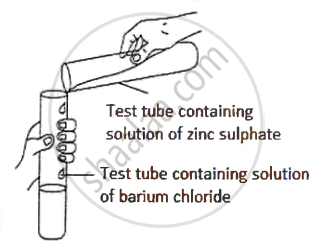
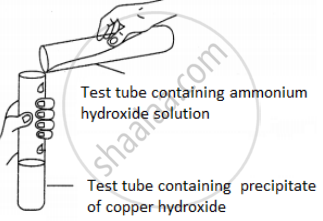
A student was asked to perform an experiment in the laboratory based on the instructions given:
Observe the picture given below and state one observation for the experiment you would notice on mixing the given solution.
LONG ANSWER TYPE:
You are provided with two reagent bottles marked A and B. One of which contains NH4OH solution and the other contains NaOH solution. How will you identify them by a chemical test?
Write a balanced equation for the following conversion:
\[\ce{ZnSO4 ->[A]Zn(OH)2->[B]Na2ZnO2}\]
Write a balanced equation for the following conversion:
\[\ce{CuSO4 ->[A]Cu(OH)2 ->[B] [Cu(NH3)4]SO4}\]
What do you understand by amphoteric oxide?
Give the balanced equations for the reaction with two different amphoteric oxides with a caustic alkali.
Name the products formed when the reaction with two different amphoteric oxides with a caustic alkali.
On adding dilute ammonia solution to a colourless solution of a salt, a white gelatinous precipitate appears. This precipitate however dissolves on addition of excess of ammonia solution.
- From the following list, identify which metal salt solution is used above?
Na, Al, Zn, Pb, Fe - What is the formula of the white gelatinous precipitate obtained?
- Give the balanced equation(s) when sulphate of this metal reacts with ammonia solution in excess.
Distinguish by adding:
Sodium hydroxide solution or ammonium hydroxide solution to ferrous salt solution and lead salt solution
Distinguish by adding:
Sodium hydroxide solution and ammonium hydroxide solution to lead nitrate solution and zinc nitrate solution.
Distinguish by adding:
Sodium hydroxide solution and ammonium hydroxide solution to copper salt solution and ferrous salt solution.
Distinguish by adding:
Sodium hydroxide solution and ammonium hydroxide solution to Fe(II) salt solution and Fe(III) salt solution.
Distinguish by adding:
Sodium hydroxide solution and ammonium hydroxide solution to ferrous nitrate and lead nitrate.
Solutions for 4: Analytical Chemistry
S.P. Singh solutions for कन्साइस केमिस्ट्री [इंग्रजी] इयत्ता १० आयसीएसई chapter 4 - Analytical Chemistry
Shaalaa.com has the CISCE Mathematics कन्साइस केमिस्ट्री [इंग्रजी] इयत्ता १० आयसीएसई CISCE solutions in a manner that help students grasp basic concepts better and faster. The detailed, step-by-step solutions will help you understand the concepts better and clarify any confusion. S.P. Singh solutions for Mathematics कन्साइस केमिस्ट्री [इंग्रजी] इयत्ता १० आयसीएसई CISCE 4 (Analytical Chemistry) include all questions with answers and detailed explanations. This will clear students' doubts about questions and improve their application skills while preparing for board exams.
Further, we at Shaalaa.com provide such solutions so students can prepare for written exams. S.P. Singh textbook solutions can be a core help for self-study and provide excellent self-help guidance for students.
Concepts covered in कन्साइस केमिस्ट्री [इंग्रजी] इयत्ता १० आयसीएसई chapter 4 Analytical Chemistry are Chemical Analysis, Action of Sodium Hydroxide Solution on Certain Metallic Salt Solutions, Action of Ammonium Hydroxide on Certain Salt Solutions, Action of Alkalis on Certain Metals, Action of Alkalis on Metal Oxides, Colours of the Salts and Their Solutions, Chemical Analysis, Action of Sodium Hydroxide Solution on Certain Metallic Salt Solutions, Action of Ammonium Hydroxide on Certain Salt Solutions, Action of Alkalis on Certain Metals, Action of Alkalis on Metal Oxides, Colours of the Salts and Their Solutions, Chemical Analysis, Action of Sodium Hydroxide Solution on Certain Metallic Salt Solutions, Action of Ammonium Hydroxide on Certain Salt Solutions, Action of Alkalis on Certain Metals, Action of Alkalis on Metal Oxides, Colours of the Salts and Their Solutions.
Using S.P. Singh कन्साइस केमिस्ट्री [इंग्रजी] इयत्ता १० आयसीएसई solutions Analytical Chemistry exercise by students is an easy way to prepare for the exams, as they involve solutions arranged chapter-wise and also page-wise. The questions involved in S.P. Singh Solutions are essential questions that can be asked in the final exam. Maximum CISCE कन्साइस केमिस्ट्री [इंग्रजी] इयत्ता १० आयसीएसई students prefer S.P. Singh Textbook Solutions to score more in exams.
Get the free view of Chapter 4, Analytical Chemistry कन्साइस केमिस्ट्री [इंग्रजी] इयत्ता १० आयसीएसई additional questions for Mathematics कन्साइस केमिस्ट्री [इंग्रजी] इयत्ता १० आयसीएसई CISCE, and you can use Shaalaa.com to keep it handy for your exam preparation.
