Advertisements
Advertisements
प्रश्न
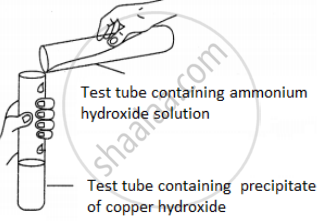
A student was asked to perform an experiment in the laboratory based on the instructions given:
Observe the picture given below and state one observation for the experiment you would notice on mixing the given solution.
Advertisements
उत्तर
Blue precipitate dissolves to form an inky blue/deep blue solution.
Explanation:
The light blue precipitate of copper(II) hydroxide (Cu(OH)2) dissolves in excess of ammonium hydroxide due to the formation of a deep blue complex, tetraamminecopper(II) ([Cu(NH3)4]2+), making it soluble.
APPEARS IN
संबंधित प्रश्न
State one relevant observation for given reactions:
Action of Sodium hydroxide solution on ferrous sulfate solution.
Name the kind of particles present in sodium hydroxide solution.
Name a yellow monoxide that dissolves in hot and concentrated caustic alkali.
Distinguish by adding:
(a) sodium hydroxide solution and
(b) Ammonium hydroxide solution to
(i) Calcium salt solution and lead salt solution
(ii) Lead salt solution and ferrous salt solution
(iii) copper salt solution and ferrous salt solution
(iv) Fe (II) salt solution and Fe (III) Salt solution
(v) Ferrous nitrate and lead nitrate
Write equation for the reaction that will take place when copper sulphate solution is added to sodium hydroxide solution.
Write balanced equation reaction of sodium hydroxide solution with iron (III) chloride solution.
What is observed when hot, concentrated caustic soda solution is added to zinc? Write a balanced equation.
Identify the cation in the following case:
Sodium hydroxide solution when added to Solution C gives a white precipitate which is insoluble in excess of sodium hydroxide solution.
Name the metal hydroxides which are insoluble in caustic soda solution.
Write the word equation when ammonium salt is heated with caustic soda solution.
