Advertisements
Advertisements
Question
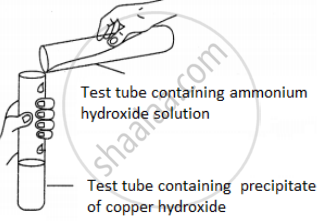
A student was asked to perform an experiment in the laboratory based on the instructions given:
Observe the picture given below and state one observation for the experiment you would notice on mixing the given solution.
Advertisements
Solution
Blue precipitate dissolves to form an inky blue/deep blue solution.
Explanation:
The light blue precipitate of copper(II) hydroxide (Cu(OH)2) dissolves in excess of ammonium hydroxide due to the formation of a deep blue complex, tetraamminecopper(II) ([Cu(NH3)4]2+), making it soluble.
APPEARS IN
RELATED QUESTIONS
What do you observe when caustic soda solution is added to the following solution, first a little and then in excess:
ZnSO4
Write a balanced equation for this reaction.
Using sodium hydroxide solution, how will you distinguish:
Iron (II) chloride from iron (III) chloride
Using sodium hydroxide solution, how will you distinguish:
Lead hydroxide from magnesium hydroxide.
Choose the correct answer from the options given below :
Hydroxide of this metal is soluble is sodium hydroxide solution
Write balanced equation reaction of sodium hydroxide solution with iron (III) chloride solution.
Distinguish by adding:
Sodium hydroxide solution and ammonium hydroxide solution to lead nitrate solution and zinc nitrate solution.
Distinguish by adding:
Sodium hydroxide solution and ammonium hydroxide solution to ferrous nitrate and lead nitrate.
What is observed when hot, concentrated caustic soda solution is added to zinc? Write a balanced equation.
What is observed when hot, concentrated caustic soda solution is added to aluminium? Write a balanced equation.
State one relevant observation for the following:
To the copper nitrate solution, initially, few drops of sodium hydroxide solution is added and then added in excess.
