Advertisements
Advertisements
प्रश्न
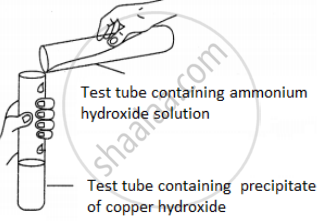
A student was asked to perform an experiment in the laboratory based on the instructions given:
Observe the picture given below and state one observation for the experiment you would notice on mixing the given solution.
Advertisements
उत्तर
Blue precipitate dissolves to form an inky blue/deep blue solution.
Explanation:
The light blue precipitate of copper(II) hydroxide (Cu(OH)2) dissolves in excess of ammonium hydroxide due to the formation of a deep blue complex, tetraamminecopper(II) ([Cu(NH3)4]2+), making it soluble.
APPEARS IN
संबंधित प्रश्न
What do you observe when caustic soda solution is added to the following solution, first a little and then in excess:
ZnSO4
Write a balanced equation for this reaction.
What do you observe when caustic soda solution is added to the following solution, first a little and then in excess:
Pb(NO3)2
Write balanced equation for this reaction.
Name the chloride of a metal which is soluble in excess of ammonium hydroxide. Write equation for the same.
Distinguish by adding:
(a) sodium hydroxide solution and
(b) Ammonium hydroxide solution to
(i) Calcium salt solution and lead salt solution
(ii) Lead salt solution and ferrous salt solution
(iii) copper salt solution and ferrous salt solution
(iv) Fe (II) salt solution and Fe (III) Salt solution
(v) Ferrous nitrate and lead nitrate
Three test tubes contain calcium nitrate solution, zinc nitrate solution and lead nitrate solution respectively. Each solution is divided into two portions (i) and (ii). Describe the effect of
- adding sodium hydroxide solution to each portion in turn till it is in excess.
- adding ammonium hydroxide to each portion in turn till it is in excess.
Identify the substance Q based on the information given below:
The white crystalline solid Q is soluble in water. It liberates a pungent smelling gas when heated with sodium hydroxide solution.
Identify the cation in the following case:
Sodium hydroxide solution when added to Solution C gives a white precipitate which is insoluble in excess of sodium hydroxide solution.
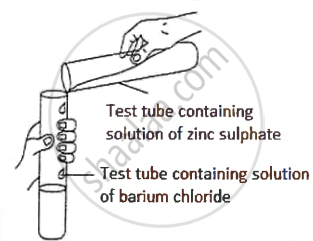
A student was asked to perform an experiment in the laboratory based on the instructions given:
Observe the picture given below and state one observation for the experiment you would notice on mixing the given solution.
Name the metal hydroxides which are insoluble in caustic soda solution.
Write the word equation when ammonium salt is heated with caustic soda solution.
