Advertisements
Advertisements
Question
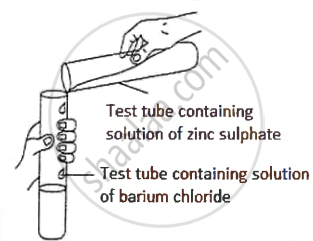
A student was asked to perform an experiment in the laboratory based on the instructions given:
Observe the picture given below and state one observation for the experiment you would notice on mixing the given solution.
Advertisements
Solution
White precipitate of barium sulphate is formed.
Explanation:
When a solution of zinc sulphate is added to a solution of barium chloride, a double displacement reaction occurs. This reaction involves the exchange of ions between the two compounds and a white precipitate of barium sulphate is formed.
\[\ce{ZnSO4_{(aq)} + BaCl2_{(aq)} -> BaSO4_{(s)} + ZnCl2_{(aq)}}\]
APPEARS IN
RELATED QUESTIONS
What do you observe when caustic soda solution is added to the following solution, first a little and then in excess:
FeCl3
Write a balanced equation for this reaction.
Name the chloride of a metal which is soluble in excess of ammonium hydroxide. Write equation for the same.
Distinguish by adding:
(a) sodium hydroxide solution and
(b) Ammonium hydroxide solution to
(i) Calcium salt solution and lead salt solution
(ii) Lead salt solution and ferrous salt solution
(iii) copper salt solution and ferrous salt solution
(iv) Fe (II) salt solution and Fe (III) Salt solution
(v) Ferrous nitrate and lead nitrate
What do you observe when ammonium salt is heated with caustic soda solution?
Using Sodium hydroxide solution, how would you distinguish: Ammonium sulphate from sodium sulphate.
Using Sodium hydroxide solution, how would you distinguish: Iron(II) chloride from Iron (III) chloride
Sodium hydroxide solution is added first in a small quantity, then in excess to the aqueous salt solutions of copper (II) sulphate, zinc nitrate, lead nitrate, calcium chloride, and iron (III) sulphate. Copy the following table and write the colour of the precipitate in (i) to (v) and the nature of the precipitate (soluble or insoluble) in (vi) to (x).
| Aqueous salt solution | Colour of precipitate when NaOH is added in a small quantity | Nature of precipitate (soluble or insoluble) when NaOH is added in excess |
| Copper (II) sulphate | (i) | (vi) |
| Zinc nitrate | (ii) | (vii) |
| Lead nitrate | (iii) | (viii) |
| Calcium chloride | (iv) | (ix) |
| Iron (III) Sulphate | (v) | (x) |
Sodium hydroxide solution is added to the solutions containing the ions mentioned in List X. List Y gives the details of the precipitate. Match the ions with their coloured precipitates.
| List X | List Y |
| (i) Pb2+ | (A) Reddish Brown |
| (ii) Fe2+ | (B) White insoluble inexcess |
| (iii) Zn2+ | (C) Dirty green |
| (iv) Fe3+ | (D) White soluble in excess |
| (v) Cu2+ | (E) White soluble in excess |
| (vi) Ca2+ | (F) Blue |
Identify the cation in the following case:
Sodium hydroxide solution when added to Solution C gives a white precipitate which is insoluble in excess of sodium hydroxide solution.
A student was asked to perform an experiment in the laboratory based on the instructions given:
Observe the picture given below and state one observation for the experiment you would notice on mixing the given solution.