Advertisements
Online Mock Tests
Chapters
▶ 1: Cell Cycle and Cell Division
2: Structure of Chromosome
3: Genetics
Unit 2: Plant Physiology
4: Absorption by Roots
5: Transpiration
6: Photosynthesis
7: Chemical Coordination in Plants
Unit 3: Human Anatomy and Physiology
8: Circulatory System
9: Human Excretory System
10: Nervous System
11: Sense Organs
12: Endocrine System
13: Reproductive System
Unit 4: Population
14: Population
Unit 5: Human Evolution
15: Human Evolution
Unit 6: Pollution
16: Pollution
![Lakhmir Singh solutions for बायोलॉजी [इंग्रजी] इयत्ता १० आईसीएसई chapter 1 - Cell Cycle and Cell Division - Shaalaa.com](/images/biology-english-class-10-icse_6:7181a54a5d284da8b50dd2f92022a1f6.jpg "Lakhmir Singh solutions for बायोलॉजी [इंग्रजी] इयत्ता १० आईसीएसई chapter 1 - Cell Cycle and Cell Division")
Advertisements
Solutions for Chapter 1: Cell Cycle and Cell Division
Below listed, you can find solutions for Chapter 1 of CISCE Lakhmir Singh for बायोलॉजी [इंग्रजी] इयत्ता १० आईसीएसई.
Lakhmir Singh solutions for बायोलॉजी [इंग्रजी] इयत्ता १० आईसीएसई 1 Cell Cycle and Cell Division Intex Quesions [Pages 5 - 13]
THINK AND ANSWER
Unlike a eukaryotic cell, a prokaryotic cell does not have chromosomes, so how does cell division takes place?
A cell with 23 chromosomes undergoes mitosis. What will be the chromosome number of the cell during metaphase and during anaphase?
What happens if the cell divisions go uncontrolled?
TEST YOUR UNDERSTANDING - 1 Fill in the Blanks
In ______ organisms, all the functions are carried out by a single cell.
______ gave the term cell to honeycomb-like structures that he saw under his self-made microscope.
True or False.
A single cell cannot exist independently.
True or False.
The discovery of the cell had a great impact on the study of life science.
Name the Scientist:
Discovered and named the nucleus in plant cells.
Name the Scientist.
Established that nucleus was responsible for storing and transmitting hereditary characters.
TEST YOUR UNDERSTANDING - 2 Fill in the Blanks
______ is the type of cell division occurring in the cells of injured parts of the body.
______ is the organelle of the cell that initiates cell division.
The centrosome is present near the ______ in an animal cell.
True or False.
Nucleolus reappears during telophase.
True or False.
Lysosome is a part of the cell in which chromosomes are present.
True or False.
The resting stage in mitosis is called interphase.
Lakhmir Singh solutions for बायोलॉजी [इंग्रजी] इयत्ता १० आईसीएसई 1 Cell Cycle and Cell Division EXERCISE [Pages 17 - 21]
Objective Questions
True or False.
Mitosis is the type of cell division occurring in the cells of injured parts of the body.
True or False.
Mitosis is a type of cell division that take place in all organisms.
True or False.
At the metaphase stage the chromosomes are separated and pulled to opposite poles.
True or False.
In animal cells at telophase stage, the cells divide by cell plate formation.
True or False.
Mitosis takes place in the vegetative parts of the plants and the somatic part of the animals.
Fill in the Blanks
Cell theory was first given by ______ and ______.
Cell theory was refined by ______.
A human gamete contains ______ chromosomes whereas a normal body cell has ______ chromosomes in it.
The astral rays/fibres that attach to ______ originate from centrioles at opposite poles.
At ______ stage the daughter nuclei are formed.
Match the Following:
| Column I | Column II |
| (i) G2-phase | (a) Shortest phase of cell division |
| (ii) Anaphase | (b) Division of nucleus during cell division |
| (iii) S-phase | (c) Division of cytoplasm during cell division |
| (iv) Karyokinesis | (d) Synthesis of RNA and protein |
| (v) Cytokinesis | (e) Duplication of DNA |
Give One Word Answers.
Name the scientist who first studied living cell.
Give One Word Answers.
Name the publication in which Robert Hooke (1665) described his discovery of the cell.
Give One Word Answers.
Name the largest cell in human body.
Give One Word Answers.
Name the longest animal cell.
Give One Word Answers.
The type of cell division which occurs in the cells of the reproductive organs.
Multiple Choice Questions
Chromosomes condense at the ______ of interphase.
G2 phase
S-phase
G1 phase
Karyokinesis
Division of cytoplasm is called ______.
Cytokinesis
Cytosis
Cytonemosis
Cytoneurosis
This organelle is visible only during cell division.
Chromosome
Centromere
Centriole
Nucleolus
______ is the resting phase of the cell cycle.
G2 phase
S-phase
G1 phase
G0 phase
The idea 'omins cellula e cellula' which means that all living cells arise from pre-existing cells was given by:
Robert Brown
Purkinje
Rudolf Virchow
Schleiden
Which of the following has an irregular or variable shape?
Euglena
Paramecium
Amoeba
Acetabularia
The process of cell multiplication is called ______.
Cell division
Cell growth
Cell movement
Cell respiration
The number of chromosomes in parents and offsprings of a particular species undergoing sexual reproduction remain constant due to:
doubling of chromosomes after zygote formation.
the halving of chromosomes during gamete formation.
doubling of chromosomes after gamete formation.
the halving of chromosomes after gamete formation.
The ratio of the number of chromosomes in a human zygote and a human sperm is ______
2 : 1
3 : 1
1 : 2
1 : 3
The normal body cell of an organism contains 28 pairs of chromosomes. The number of chromosomes present in its germ cell will be:
28
14
56
42
Descriptive Questions Short Answer Questions
What is a functional unit of life?
Write the difference on the basis of what is given in the brackets: karyokinesis and cytokinesis (explain the term).
Name the phases of the cell cycle.
Where does mitosis occur in animals?
Where does meiosis occur in animals?
Where does mitosis occur in plants?
Where does meiosis occur in plants?
What kind of division occurs in pollen grains?
Give One Word Answers.
The type of cell division which occurs in the cells of the reproductive organs.
Give the exact location of the centrosome.
Draw a well labelled diagram to show the metaphase stage of mitosis in an animal cell having four chromosomes.
Differentiate between Human skin cell and Human ovum (number of chromosomes).
Differentiate between
Mitosis and Meiosis.
Differentiate between centrosome and centromere.
Long Answer Questions
Explain why meiosis is called reduction division.
Where does crossing over occur?
Write briefly about cell organelles.
What do you understand by cell cycle?
Explain the three main stages of the cell cycle.
Diagram Based Questions
Given alongside is a diagram representing a stage during the mitotic cell division. Study the diagram and answer the following questions:
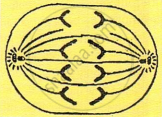
- Identify the stage by giving a suitable reason.
- Is it a plant or an animal cell? Give a reason to support your answer.
- Draw a neat, labelled diagram of the stage which follows the one shown in the diagram.
- How many chromosomes will each daughter cell have after the completion of the above division?
- Name the four nitrogenous bases.
The diagram given below represents a stage during cell division.
Study the same and answer the questions that follow:

- Identify whether it is a plant cell or an animal cell. Give a reason in support of your answer.
- Name the stage depicted in the diagram. What is the unique feature observed in this stage?
- Name the type of cell division that occurs during:
- Replacement of old leaves by new ones
- Formation of gametes
- What is the stage that comes before the stage shown in the diagram?
- Draw a neat, labelled diagram of the stage mentioned in (iv) above keeping the chromosome number constant.
Study the diagram given alongside which represents a stage during the mitotic cell division and answer the questions that follow:
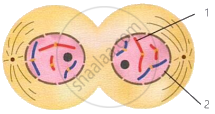
- Identify the stage giving suitable reasons.
- Name the parts numbered 1 and 2.
- What is the technical term for the division of nucleus?
- Mention the stage that comes before the stage shown in the diagram. Draw a neat labelled diagram of the stage mentioned.
- Which is the cell division that results in half the number of chromosomes in daughter cells?
The given diagram shows a stage during mitotic division in an animal cell:

- Identify the stage. Give a reason to support your answer.
- Draw a neat labelled diagram of the cell as it would appear in the next stage. Name the stage.
- In what two ways is mitotic division in an animal cell different from the mitotic division in a plant cell?
- Name the type of cell division that occurs during:
- Growth of a shoot
- Formation of pollen grains.
Study the diagram given below and answer the given questions:
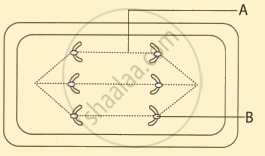
- Identify the stage of cell division.
- Name the parts labelled as A and B.
- How many daughter cells are formed from this type of cell division?
The diagram below represents a stage during cell division. Study the same and then answer the questions that follow:

- Name the parts labelled 1, 2, and 3.
- Identify the above stage and give a reason to support your answer.
- Mention where in the body this type of cell division occurs.
- Name the stage prior to this stage and draw a diagram to represent the same.
Given below is a diagram representing a stage during mitotic cell division in an animal cell:
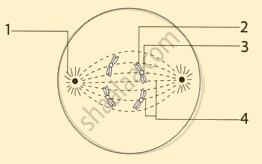
- Identify the above stage. Give a reason to support your answer.
- Name the parts labelled 1, 2, 3, and 4.
- What is the function of part 3?
- Name the stage that comes just after the stage shown in the diagram. Draw a well-labelled diagram of this stage.
DO IT RIGHT
You are given a project to display different parts of cell organelles (as a 3D model) for your term assessment along with the explanation about chromosomes.
To make a cell: Take a round yellow plastic ball (about the size of a tennis ball). Cut it into equal halves. In one half (lower part) of the ball, add transparent gel-like material (e.g., sanitiser, hair gel). Make colourful organelles having shapes similar to those found in a cell. Use thermocole or small plastic sheets to make organelles. Make sure you make all the important organelles: Golgi body, Mitochondria, Endoplasmic reticulum, Vacuoles, Nucleus, Lysosome (one each). They should all float.
To make nucleus: Take a TT ball and cut it into half. Fill the lower half also with a gel-like substance. Add small springs (you can use the ones you have in your ball pens). Close the ball with the upper part of the half. Add a few drops of fevicol on the edges. Now float it inside the yellow plastic ball along with the other organelles. Your cell is ready.
Now, prepare your speech and explain each organelle as you display them.
Solutions for 1: Cell Cycle and Cell Division
Lakhmir Singh solutions for बायोलॉजी [इंग्रजी] इयत्ता १० आईसीएसई chapter 1 - Cell Cycle and Cell Division
Shaalaa.com has the CISCE Mathematics बायोलॉजी [इंग्रजी] इयत्ता १० आईसीएसई CISCE solutions in a manner that help students grasp basic concepts better and faster. The detailed, step-by-step solutions will help you understand the concepts better and clarify any confusion. Lakhmir Singh solutions for Mathematics बायोलॉजी [इंग्रजी] इयत्ता १० आईसीएसई CISCE 1 (Cell Cycle and Cell Division) include all questions with answers and detailed explanations. This will clear students' doubts about questions and improve their application skills while preparing for board exams.
Further, we at Shaalaa.com provide such solutions so students can prepare for written exams. Lakhmir Singh textbook solutions can be a core help for self-study and provide excellent self-help guidance for students.
Concepts covered in बायोलॉजी [इंग्रजी] इयत्ता १० आईसीएसई chapter 1 Cell Cycle and Cell Division are .
Using Lakhmir Singh बायोलॉजी [इंग्रजी] इयत्ता १० आईसीएसई solutions Cell Cycle and Cell Division exercise by students is an easy way to prepare for the exams, as they involve solutions arranged chapter-wise and also page-wise. The questions involved in Lakhmir Singh Solutions are essential questions that can be asked in the final exam. Maximum CISCE बायोलॉजी [इंग्रजी] इयत्ता १० आईसीएसई students prefer Lakhmir Singh Textbook Solutions to score more in exams.
Get the free view of Chapter 1, Cell Cycle and Cell Division बायोलॉजी [इंग्रजी] इयत्ता १० आईसीएसई additional questions for Mathematics बायोलॉजी [इंग्रजी] इयत्ता १० आईसीएसई CISCE, and you can use Shaalaa.com to keep it handy for your exam preparation.
