Advertisements
Advertisements
प्रश्न
The diagram below represents a stage during cell division. Study the same and then answer the questions that follow:

- Name the parts labelled 1, 2, and 3.
- Identify the above stage and give a reason to support your answer.
- Mention where in the body this type of cell division occurs.
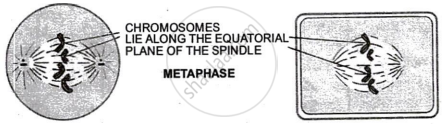
- Name the stage prior to this stage and draw a diagram to represent the same.
Advertisements
उत्तर
-
- Centrioles
- Spindle fibres
- Chromatids
- Late anaphase is a furrow starting in the cell membrane at the middle of the cell. The stage described in the diagram is the late anaphase of mitosis in an animal cell. It can be identified by the presence of separated chromatids at the cell's two poles. The appearance of the furrow in the cell membrane classifies the stage as the late anaphase.
- Mitosis occurs in somatic cells (e.g., skin, bone marrow), and meiosis occurs in germ cells within reproductive organs (ovaries and testes).
- The stage before anaphase is called the metaphase stage. During the metaphase stage, the chromosomes are aligned at the equatorial region of the cell. The spindles arising from the centrioles get attached to the chromosomes at centromeres. The chromosomes are in the most condensed state in this phase. The below diagram shows the metaphase stage of mitosis:
संबंधित प्रश्न
The diagram given below represents a stage during cell division.
Study the same and answer the questions that follow:

- Identify whether it is a plant cell or an animal cell. Give a reason in support of your answer.
- Name the stage depicted in the diagram. What is the unique feature observed in this stage?
- Name the type of cell division that occurs during:
- Replacement of old leaves by new ones
- Formation of gametes
- What is the stage that comes before the stage shown in the diagram?
- Draw a neat, labelled diagram of the stage mentioned in (iv) above keeping the chromosome number constant.
Fill in the blank:
______ takes place in body cells resulting in growth and development.
The fig given alongside shows a certain stage in a cell division in a cell with four chromosomes.
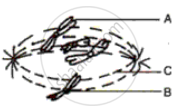
(i) Name the parts of the chromosome labeled A and B.
(ii) Name the structure C. what is its function?
(iii) Name the type of division . Give a reason.
(iv) Name the stage of division.
(v) Name the stages before and after the stage shown in diagram.
In which one of the following options the two stages of mitosis have been given in correct sequence?
The diagram below represents a certain stage of a cell.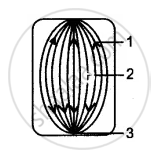
(i) Is it an animal cell or a plant cell ? Give one reason in support of your answer.
(ii) Label the parts numbered 1 – 3.
(iii) Which stage (phase) of mitosis is represented in this diagram
Draw a labeled schematic representation of mitosis cell division.
Name the following:
Replacement of dead cells is accomplished by which process.
Name the following:
The kind of division normally seen at the tip of the root and shoot system.
Multiple Choice Question:
The nuclear membrane disappears in
Write the functional activity of the following structure:
Colchicine
Column ‘II’ is a list of items related to ideas in Column ‘I’. Match the terms in Column ‘II’ with a suitable idea given in Column ‘I’.
| Column I | Column II |
| (i) Anaphase | (a) Chromosomes become arranged in a horizontal plane at the equator. |
| (ii) Prophase | (b) Daughter chromosomes move to opposite poles of the spindle. |
| (iii) Telophase | (c) Chromosomes become visible as fine, long threads. |
| (iv) Metaphase | (d) Chromosomes lose their distinctiveness and gradually become transformed into chromatin network. |
Explain the following figure.

The diagram given below represents a stage in mitosis.

- Identify the stage given above.
- Give one reason to support your answer in (a).
- Mention the number of chromosomes given in the diagram.
During Mitosis what is the position of chromatids in the anaphase?
Name these:
Two steps of the process Mitosis
