Advertisements
Online Mock Tests
Chapters
1: Cell Cycle and Cell Division
2: Structure of Chromosome
3: Genetics
Unit 2: Plant Physiology
4: Absorption by Roots
5: Transpiration
▶ 6: Photosynthesis
7: Chemical Coordination in Plants
Unit 3: Human Anatomy and Physiology
Chapter 8: Circulatory System
Chapter 9: Human Excretory System
Chapter 10: Nervous System
Chapter 11: Sense Organs
Chapter 12: Endocrine System
Chapter 13: Reproductive System
Unit 4: Population
Chapter 14: Population
Unit 5: Human Evolution
Chapter 15: Human Evolution
Unit 6: Pollution
Chapter 16: Pollution
![Lakhmir Singh solutions for बायोलॉजी [इंग्रजी] इयत्ता १० आईसीएसई chapter 6 - Photosynthesis - Shaalaa.com](/images/biology-english-class-10-icse_6:7181a54a5d284da8b50dd2f92022a1f6.jpg "Lakhmir Singh solutions for बायोलॉजी [इंग्रजी] इयत्ता १० आईसीएसई chapter 6 - Photosynthesis")
Advertisements
Solutions for Chapter 6: Photosynthesis
Below listed, you can find solutions for Chapter 6 of CISCE Lakhmir Singh for बायोलॉजी [इंग्रजी] इयत्ता १० आईसीएसई.
Lakhmir Singh solutions for बायोलॉजी [इंग्रजी] इयत्ता १० आईसीएसई 6 Photosynthesis Intex Quesions [Pages 88 - 98]
DO YOU KNOW?
How does plants with red leaves trap sunlight?
How does aquatic plant receive CO2 for photosynthesis?
Cellular respiration is reverse of photosynthesis. Explain.
TEST YOUR UNDERSTANDING - 1 Fill in the Blanks
Organisms which can prepare their own food are known as ______.
The process by which plants make food and life is sustained on the earth is ______.
The green pigment responsible for photosynthesis is known as ______.
True or False.
Glucose is the by-product of photosynthesis.
Solar energy is converted into chemical energy during photosynthesis.
True
False
Carbon dioxide is released during photosynthesis.
True
False
Multiple Choice Questions
Which of these is not required for photosynthesis?
Carbon dioxide
Water
Oxygen
Sunlight
The products formed during photosynthesis are ______.
Glucose, oxygen and water
Glucose and oxygen
Starch and oxygen
Starch, water and oxygen
TEST YOUR UNDERSTANDING - 2 Fill in the Blanks
Chloroplasts are found in the ______ cells of the leaves.
The flattened sacs in chloroplasts are known as ______.
Too much ______ can destroy chlorophyll.
True or False.
Chloroplasts are only found in green leaves.
True or False.
Guard cells become turgid due to leaking out of potassium ions at night.
True or False.
Light is necessary for synthesis of chlorophyll.
Multiple Choice Questions
Chloroplasts are found in ______ in the leaf.
Lower epidermis
Palisade mesophyll
Spongy mesophyll
Both palisade and spongy mesophyll
The ground material of chloroplasts is known as ______.
Matrix
Stroma
Thylakoid
Grana
TEST YOUR UNDERSTANDING - 3 Fill in the Blanks
The dark reaction takes place in ______.
During photosynthesis oxygen is evolved from ______.
Glucose produced during photosynthesis is polymerised into ______.
True or False.
Photosynthesis stops at 40°C.
True or False.
The dark reaction occurs during nighttime.
True or False.
The rate of photosynthesis keeps on increasing with increasing intensity of light.
Multiple Choice Questions
The optimum temperature range for photosynthesis is ______.
25-35°C
10-15°C
35-40°C
20-25°C
Light reaction takes place in ______.
Grana
Stroma
Cytoplasm
Ribosome
TEST YOUR UNDERSTANDING - 4 Fill in the Blanks
The starting and ending point of carbon cycle is ______.
______ of dead and decaying organisms'releases carbon dioxide into the atmosphere.
In carbon cycle ______ is the main element.
True or False.
Burning of fossil fuels releases carbon dioxide into the air.
True or False.
The source of carbon to the plants in the carbon cycle is atmospheric carbon dioxide.
True or False.
Bacteria and fungi do not contribute to the carbon cycle.
Multiple Choice Questions
The factor contributing to the carbon cycle is:
Fossil fuels combustion
Respiration
Photosynthesis
All of these
Humans contribute to the carbon cycle through ______.
Formation of glucose
Cellular respiration
Photosynthesis
Waste products
Lakhmir Singh solutions for बायोलॉजी [इंग्रजी] इयत्ता १० आईसीएसई 6 Photosynthesis EXERCISE [Pages 100 - 103]
Objective Questions
True or False.
The leaves appear green because they absorb green light.
True or False.
The photosystems of photosynthesis are found in the thylakoid membranes.
True or False.
The light reactions take place in the nucleus.
True or False.
Chlorophyll determines the types of visible light that can be used for photosynthesis.
True or False.
The carbon fixation occurs in the light reactions of photosynthesis.
Fill in the Blanks
Photosynthesis converts light energy to ______ energy.
The inputs of photosynthesis include CO2, sunlight and ______.
Presence of ______ in leaves can be tested with iodine solution.
The products of light-dependent reaction are ______, ATP and oxygen.
Full form of ATP is ______.
Match the Following.
| Column I | Column II |
| (i) Thylakoid membrane | (a) Dark reaction |
| (ii) Stroma | (b) Iodine solution |
| (iii) Chlorophyll | (c) Fixation of carbon dioxide |
| (iv) Starch test | (d) Primary producers |
| (v) Calvin cycle | (e) Gaseous exchange |
| (vi) Stomata | (f) Absorb light |
| (vii) Plants | (g) Chlorophyll |
Name the following:
The category of organisms that prepare their own food from basic raw materials.
Give One Word Answer.
Stacks of thylakoids.
Name the following:
The first form of food substance produced during photosynthesis.
Give One Word Answer.
Pigment that traps light energy.
Give One Word Answer.
Natural purifiers of air.
Multiple Choice Questions
The rate of photosynthesis is affected by:
Temperature
Light intensity
Surface area of leaf
All of these
The main role of chlorophyll is to ______.
break down water
trap light energy
store starch
synthesise starch
Light energy trapped by chlorophyll is used to ______.
reducе СО2
split water
activate chlorophyll
synthesise starch
The end product of photosynthesis is ______.
CO2
Starch
Glucose
Fats
Glucose produced during photosynthesis is temporarily stored as ______.
Starch
Sugar
Fats
All of these
Descriptive Questions Short Answer Questions
Why destarched plants are used in experiments on photosynthesis?
Why are leaves called food factories of plant?
Which products formed during the light reaction of photosynthesis are used to drive the dark reaction?
Why does the rate of photosynthesis decrease at higher temperatures?
Why leaves of a plant turn yellow when they do not get sunlight?
Complete the following by filling the blanks 1 to 5 with appropriate words/terms/phrases:
To test the leaf for starch, the leaf is boiled in water to ______ (1). It is next boiled in methylated spirit to ______ (2). The leaf is placed in warm water to soften it. It is then placed in a dish and ______ (3) solution is added. The region which contains starch, turns ______ (4) and the region which does not contain starch, turns ______ (5)
Differentiate between the producers and consumers.
Differentiate Between:
Chloroplast and Chlorophyll
Differentiate Between:
Light reaction and Dark reaction.
Long Answer Questions
All life is dependent on chlorophyll. Explain.
Can we say that chloroplasts are the kitchen of a cell?
Describe the main chemical changes which occur during photosynthesis in a dark reaction.
Describe the main chemical changes which occur during photosynthesis in a light reaction.
Oxygen is a waste product of photosynthesis. Is this statement correct? Explain.
Explain the mechanism that brings about closure of stomata.
What is the significance of photosynthesis?
Draw a neat and well-labeled diagram of the Chloroplast.
A potted plant was taken in order to prove a factor necessary for photosynthesis. The potted plant was kept in the dark for 24 hours. One of the leaves was covered with black paper in the centre.The potted plant was then placed in sunlight for a few hours.
- What aspect of photosynthesis was being tested?
- Why was the plant placed in the dark before beginning the experiment?
- During the starch test why was the leaf
- boiled in water
- boiled in methylated spirit
- Write a balanced chemical equation to represent the process of photosynthesis.
- Draw a neat diagram of a chloroplast and label its parts.
Diagram Based Questions
The diagram given below represents an experiment to prove the importance of a factor in photosynthesis. Answer the questions that follow:
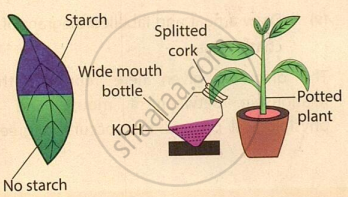
- Which factor is being studied here?
- What is the purpose of keeping KOH in the flask?
- Explain the term photosynthesis.
- What will you observe when the leaf is tested for starch?
- Write awell-balanced chemicalequation for the process of photosynthesis.
A potted plant with variegated leaves was taken in order to prove a factor necessary for photosynthesis. The potted plant was kept in the dark for 24 hours and then placed in bright sunlight for a few hours. Observe the diagrams and answer the questions:

- What aspect of photosynthesis is being tested in the above diagram?
- Represent the process of photosynthesis in the form of a balanced equation.
- Why was the plant kept in the dark before beginning the experiment?
- What will be the result of the starch test performed on Leaf ‘A’ shown in the diagram? Give an example of a plant with variegated leaves
- Draw a neat labelled diagram of a chloroplast.
The diagrams given below represent the relationship between a mouse and a physiological process that occurs in green plants. Study the diagrams and answer the questions that follow:

- Name the physiological process occurring in the green plant that has kept the mouse alive.
- Explain the physiological process mentioned above.
- Why did the mouse die in bell jar B?
- What is the significance of the process as stated in (i) for life on earth?
- Represent the above mentioned physiological process in the form of a chemical equation.
DO IT RIGHT
Take inspiration from the poems written by famous poets.
| POEMS ON LEAVES | |
|
How silently they tumble down -by Elsie N. Brady |
Who has seen the wind? -by Christina Georgina Rossetti |
- Write your own poem about leaves depicting them as one of the most valuable asset on earth.
- Recite this poem during your class assembly.
- Make a card in shape of a leaf for your grandparents birthday. Write two lines such as
'You are my lifeline as leaves are ours'.
Solutions for 6: Photosynthesis
Lakhmir Singh solutions for बायोलॉजी [इंग्रजी] इयत्ता १० आईसीएसई chapter 6 - Photosynthesis
Shaalaa.com has the CISCE Mathematics बायोलॉजी [इंग्रजी] इयत्ता १० आईसीएसई CISCE solutions in a manner that help students grasp basic concepts better and faster. The detailed, step-by-step solutions will help you understand the concepts better and clarify any confusion. Lakhmir Singh solutions for Mathematics बायोलॉजी [इंग्रजी] इयत्ता १० आईसीएसई CISCE 6 (Photosynthesis) include all questions with answers and detailed explanations. This will clear students' doubts about questions and improve their application skills while preparing for board exams.
Further, we at Shaalaa.com provide such solutions so students can prepare for written exams. Lakhmir Singh textbook solutions can be a core help for self-study and provide excellent self-help guidance for students.
Concepts covered in बायोलॉजी [इंग्रजी] इयत्ता १० आईसीएसई chapter 6 Photosynthesis are .
Using Lakhmir Singh बायोलॉजी [इंग्रजी] इयत्ता १० आईसीएसई solutions Photosynthesis exercise by students is an easy way to prepare for the exams, as they involve solutions arranged chapter-wise and also page-wise. The questions involved in Lakhmir Singh Solutions are essential questions that can be asked in the final exam. Maximum CISCE बायोलॉजी [इंग्रजी] इयत्ता १० आईसीएसई students prefer Lakhmir Singh Textbook Solutions to score more in exams.
Get the free view of Chapter 6, Photosynthesis बायोलॉजी [इंग्रजी] इयत्ता १० आईसीएसई additional questions for Mathematics बायोलॉजी [इंग्रजी] इयत्ता १० आईसीएसई CISCE, and you can use Shaalaa.com to keep it handy for your exam preparation.
