Advertisements
Online Mock Tests
Chapters
1: Cell Cycle and Cell Division
2: Structure of Chromosome
3: Genetics
Unit 2: Plant Physiology
4: Absorption by Roots
5: Transpiration
6: Photosynthesis
7: Chemical Coordination in Plants
Unit 3: Human Anatomy and Physiology
▶ 8: Circulatory System
9: Human Excretory System
Chapter 10: Nervous System
Chapter 11: Sense Organs
Chapter 12: Endocrine System
Chapter 13: Reproductive System
Unit 4: Population
Chapter 14: Population
Unit 5: Human Evolution
Chapter 15: Human Evolution
Unit 6: Pollution
Chapter 16: Pollution
![Lakhmir Singh solutions for बायोलॉजी [इंग्रजी] इयत्ता १० आईसीएसई chapter 8 - Circulatory System - Shaalaa.com](/images/biology-english-class-10-icse_6:7181a54a5d284da8b50dd2f92022a1f6.jpg "Lakhmir Singh solutions for बायोलॉजी [इंग्रजी] इयत्ता १० आईसीएसई chapter 8 - Circulatory System")
Advertisements
Solutions for Chapter 8: Circulatory System
Below listed, you can find solutions for Chapter 8 of CISCE Lakhmir Singh for बायोलॉजी [इंग्रजी] इयत्ता १० आईसीएसई.
Lakhmir Singh solutions for बायोलॉजी [इंग्रजी] इयत्ता १० आईसीएसई 8 Circulatory System Intex Quesions [Pages 125 - 137]
TEST YOUR UNDERSTANDING - 1
True or False.
Lower animals possess some specialised internal circulatory fluids.
True or False.
Blood travels via sinuses between tissues and from lacunae.
True or False.
The respiratory pigments are present in the white blood cells of the blood that passes through this system.
Fill in the Blanks
The ______ conduct the blood from the heart to the tissues and ______ carry it back from the tissues to the heart.
Blood vascular system is basically of two types: ______ and ______ circulatory system.
TEST YOUR UNDERSTANDING - 2
Name the Scientist.
Who discovered the function of heart and the circulation of the blood?
Name the Scientist.
Who discovered capillaries?
Name the Scientist.
Who discovered the process of determining the blood pressure?
Fill in the Blanks
A contraction phase of a chamber of the heart is called a ______ and a relaxation phase is called a ______.
The blood pressure of a normal adult person is ______.
Fluids outside the cells are generally called ______ fluids.
True or False.
Approximately 70,000 miles of blood arteries make up your body.
True or False.
The capillaries also take waste products away from your tissues.
True or False.
Leucocytes are also known as thrombocytes.
THINK AND ANSWER
How long is our circulatory system? (in kilometres)
In the lifespan of a 75-year-old person, how many times did the person's heart beat?
How much blood does the heart give out in each beat and in each minute? (in millilitres or litres)
TEST YOUR UNDERSTANDING - 3 Fill in the Blanks
_________ is an extension of the circulatory system.
Lymph _________ drain into lymph nodes.
The lymph is colourless or yellowish and contains _________.
True or False:
Lymph supplies carbon dioxide to the tissues.
True or False:
Lymphatic system helps in removing cellular waste.
Lakhmir Singh solutions for बायोलॉजी [इंग्रजी] इयत्ता १० आईसीएसई 8 Circulatory System EXERCISE [Pages 138 - 141]
Objective Questions True or False
True or False.
Pulmonary artery carries oxygenated blood.
True or False.
Lymph nodes are sites of fighting infections.
True or False.
Spleen is the site of RBC destruction.
True or False.
Blood group O is the universal recipient.
True or False.
Diastole is the contraction phase of cardiac cycle.
Fill in the Blanks
Haemoglobin contains the metallic element ______.
Sickle cell anaemia is disorder of ______.
______ and ______ are agranulocytes.
______ are responsible for blood coagulation.
Electrical activity of heart starts at ______.
Match the Following:
| Column I | Column II |
|---|---|
| (i) Erythrocytes | (a) 1,000–4,000/mm3 |
| (ii) Neutrophils | (b) 4.35–5.65 million/mm3 |
| (iii) Lymphocytes | (c) 4,000–11,000/mm3 |
| (iv) Leucocytes | (d) 2,500–8,000/mm3 |
| (v) Monocytes | (e) 1,50,000–4,50,000/mm3 |
| (vi) Platelets | (f) 100–700/mm3 |
The compound formed when haemoglobin combines with carbon dioxide in blood.
Give One Word Answer.
Fluid collected in tissues that are extensions of the circulatory system.
Give One Word Answer.
Rhythmic centre that controls pumping of the heart.
Give One Word Answer.
To supplement blood loss by a person during an emergency situation.
Give One Word Answer.
Another name for platelets.
Multiple Choice Questions
Which of the following is not a component of blood?
Sodium
Oxygen
Nitrogen
Calcium
Which of the followings is required for blood coagulation?
Sodium
Magnesium
Potassium
Calcium
Which of the following elements is not present in lymph?
Erythrocytes
Fats
Leucocytes
Proteins
Blood Group AB can receive blood from
Blood Group A
Blood Group B
Blood Group O
All of these
Histamine is secreted by ______.
Neutrophils
Lymphocytes
Basophils
Eosinophils
Arteries carry ______.
Oxygenated blood
Deoxygenated blood
Blood towards the heart
Blood away from the heart
Most common type of haemoglobin is ______.
HbA
HbF
HbS
None of these
Vena Cava pours blood in ______.
Left Atrium
Right Atrium
Left Ventricle
Right Ventricle
Which of the following is not a layer of heart wall?
Pericardium
Epicardium
Myocardium
Endocardium
Oxygenated blood from lungs first reaches ______.
Left Atrium
Right Atrium
Left Ventricle
Right Ventricle
Choose the correct answer from the four options given below :
(i) While recording the pulse rate, where exactly does a doctor press on our wrist ?
Nerve
Vein
Artery
Capillary
A muscular wall is absent in ______.
Capillary
Venule
Arteriole
Vein
Descriptive Questions Short Answer Questions
Enumerate the chambers of the heart.
What are the components of blood?
What are the types of leucocytes?
Enumerate the functions of leucocytes.
What is the function of the lymphatic system?
Differentiate between:
Red blood cells (RBC) and White blood cells (WBC)
Differentiate between:
Blood and Lymph.
Differentiate between:
Diastole and Systole.
What is the difference between pulmonary circulation and systemic circulation?
Differentiate between the Following.
Plasma and Lymph
Differentiate between the following pair of terms:
Pulmonary artery and pulmonary vein.
Long Answer Questions
Explain the steps of the cardiac cycle.
Write a short note on the ABO system of blood grouping.
Write a short note on the components of blood.
What are the main steps in coagulation of blood?
Differentiate between the types of blood vessels.
Diagram Based Questions
The diagram given below represents the simplified pathway of the circulation of blood. Answer the questions that follow.
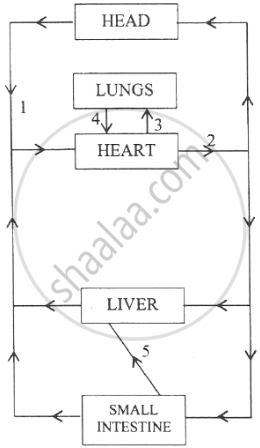
- Name the blood vessels labelled 1 to 4.
- Which blood vessel supplies oxygenated blood to the muscles of the heart?
- What is the importance of blood vessel labelled 5?
- What is the type of blood circulation that takes place between the heart and the lungs?
- Draw a diagram of the different blood cells as seen in a smear of human blood.
Given below is a diagram of a human blood smear. Study the diagram and answer the questions that follow:

- Name the components numbered ‘1’ to ‘4’.
- Mention two structural differences between the parts ‘1’ and ‘2’.
- Name the soluble protein found in part ‘4’ which forms insoluble threads during clotting of blood.
- What is the average lifespan of the component numbered ‘1’ ?
- Component numbered ‘1’ do not have certain organelles but are very efficient in their function. Explain.
DO IT RIGHT
Neelima read an article in the newspaper.
'India is one of the many countries which has a high rate of cardiovascular disease. The annual deaths due to CVD in India has risen from 2.26 million to 4.77 million. The number of deaths due to heart attack is around 25,000 - 28,000 for the past four year.'
She searched the internet to find more details as she was concerned about her ailing grandparents and her parents. She decided to ask her family doctor of why this is so prevalent and what exactly should be done. Listening to young girl expressing her desire to protect her elders, the kind doctor suggested few methods and asked her to make a strict diet chart.
- Write the methods and diet you think that the doctor has suggested.
- What values do you learn from Neelima?
Solutions for 8: Circulatory System
Lakhmir Singh solutions for बायोलॉजी [इंग्रजी] इयत्ता १० आईसीएसई chapter 8 - Circulatory System
Shaalaa.com has the CISCE Mathematics बायोलॉजी [इंग्रजी] इयत्ता १० आईसीएसई CISCE solutions in a manner that help students grasp basic concepts better and faster. The detailed, step-by-step solutions will help you understand the concepts better and clarify any confusion. Lakhmir Singh solutions for Mathematics बायोलॉजी [इंग्रजी] इयत्ता १० आईसीएसई CISCE 8 (Circulatory System) include all questions with answers and detailed explanations. This will clear students' doubts about questions and improve their application skills while preparing for board exams.
Further, we at Shaalaa.com provide such solutions so students can prepare for written exams. Lakhmir Singh textbook solutions can be a core help for self-study and provide excellent self-help guidance for students.
Concepts covered in बायोलॉजी [इंग्रजी] इयत्ता १० आईसीएसई chapter 8 Circulatory System are .
Using Lakhmir Singh बायोलॉजी [इंग्रजी] इयत्ता १० आईसीएसई solutions Circulatory System exercise by students is an easy way to prepare for the exams, as they involve solutions arranged chapter-wise and also page-wise. The questions involved in Lakhmir Singh Solutions are essential questions that can be asked in the final exam. Maximum CISCE बायोलॉजी [इंग्रजी] इयत्ता १० आईसीएसई students prefer Lakhmir Singh Textbook Solutions to score more in exams.
Get the free view of Chapter 8, Circulatory System बायोलॉजी [इंग्रजी] इयत्ता १० आईसीएसई additional questions for Mathematics बायोलॉजी [इंग्रजी] इयत्ता १० आईसीएसई CISCE, and you can use Shaalaa.com to keep it handy for your exam preparation.
