Advertisements
Advertisements
प्रश्न
Differentiate between:
Red blood cells (RBC) and White blood cells (WBC)
Advertisements
उत्तर
| Red blood cells (RBC) | White blood cells (WBC) |
| These are minute biconcave disc like structures, flat in centre, thick and round at the periphery and nuclei are absent in mature RBCs. | These collect blood from different organs of the body. |
| These contain a respiratory pigment haemoglobin. | Haemoglobin is not present. |
| RBCs help in the transport of oxygen and CO2. | WBCs help in the protection of the body against infections from the germs. |
| The number of RBCs in an adult male is 5 million per cu. millimeter. | Their number is usually about 4000-8000 per cubic millimeter. |
| Their average life span is about 120 days. | Their average life span is about two weeks. |
APPEARS IN
संबंधित प्रश्न
The diagram given below represents the human heart in one phase of its functions. Study the diagram carefully and answer the questions that follow:
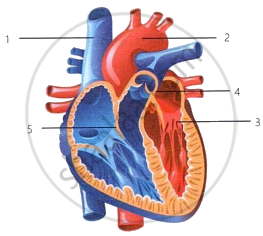
- Name the phase.
- Which part of the heart is contracting in this phase? Give a reason to support your answer.
- Name the parts labelled 1 to 4.
- What type of blood flows through 2?
- State the function of the part numbered ‘5’.
- Name the membrane that covers the heart.
Explain Pulse
The diagram below represents the simplified pathway of the circulation of blood. Study the same and answer the questions which follow:

(i) Name the blood vessels labelled 1 and 2.
(ii) State the function of blood vessels labelled 5 and 8.
(iii) What is the importance of the blood vessel labelled 6?
(iv) Which blood vessel will contain a high amount of glucose and amino acids after a meal?
(v) Draw a diagram of the different blood cells as seen in a smear of human blood.
Explain Diapedesis.
What is diastole?
True or false:
People with blood group ‘O’ are called universal recipients
Complete the following sentence with appropriate word:
Beside food, oxygen and waste materials, circulatory system transports ________ to various parts of the body.
What is the location of maturation of T-lymphocytes?
Which component of the haemoglobin molecule combines with the oxygen molecule to form oxyhaemoglobin?
Hematocrit is ______.
