Advertisements
Advertisements
प्रश्न
Differentiate between:
Red blood cells (RBC) and White blood cells (WBC)
Advertisements
उत्तर
| Red blood cells (RBC) | White blood cells (WBC) |
| These are minute biconcave disc like structures, flat in centre, thick and round at the periphery and nuclei are absent in mature RBCs. | These collect blood from different organs of the body. |
| These contain a respiratory pigment haemoglobin. | Haemoglobin is not present. |
| RBCs help in the transport of oxygen and CO2. | WBCs help in the protection of the body against infections from the germs. |
| The number of RBCs in an adult male is 5 million per cu. millimeter. | Their number is usually about 4000-8000 per cubic millimeter. |
| Their average life span is about 120 days. | Their average life span is about two weeks. |
APPEARS IN
संबंधित प्रश्न
The diagram below represents the simplified pathway of the circulation of blood. Study the same and answer the questions which follow:

(i) Name the blood vessels labelled 1 and 2.
(ii) State the function of blood vessels labelled 5 and 8.
(iii) What is the importance of the blood vessel labelled 6?
(iv) Which blood vessel will contain a high amount of glucose and amino acids after a meal?
(v) Draw a diagram of the different blood cells as seen in a smear of human blood.
Given below is a diagram of a human blood smear. Study the diagram and answer the questions that follow:

- Name the components numbered ‘1’ to ‘4’.
- Mention two structural differences between the parts ‘1’ and ‘2’.
- Name the soluble protein found in part ‘4’ which forms insoluble threads during clotting of blood.
- What is the average lifespan of the component numbered ‘1’ ?
- Component numbered ‘1’ do not have certain organelles but are very efficient in their function. Explain.
Name the following:
The artery which carries deoxygenated blood.
The valve which prevents back flow of blood in the veins and lymph vessels ______.
Name the Following
The blood plasma from which fibrinogen has been removed.
Mention, if the following statement is True or False. If false rewrite the wrong statement in its correct form:
The walls of auricles are thicker than those of ventricles.
Use your brain power!
How is the air that we inhale purified in our body?
Identify the normal haemoglobin count in human females.
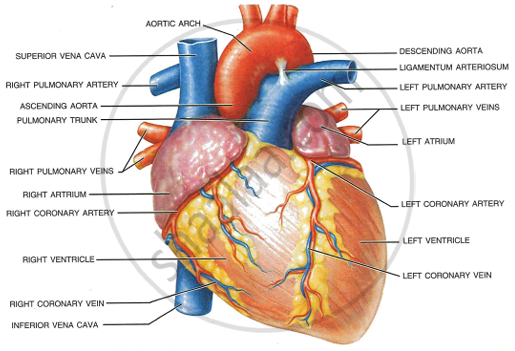 |
Can you answer why the pulmonary artery shown in Fig. is blue in colour?
Given diagram is a schematic representation of the circulatory system in humans. Study the same and answer the questions that follow:
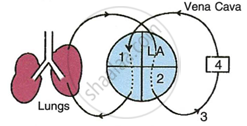 |
- Label the parts 1 and 4 indicated in the diagram.
- Which of the above mentioned number is the thickest artery? Also write its name.
- Mention the number and chamber of the heart which has the thickest muscular wall.
- Which of the above numbers/structures has the maximum number of blood capillaries?
- Draw neat and labelled diagrams of the transverse section of vena cava and the part numbered as 3. Make sure to show the structural differences between these two in the diagram.
