Advertisements
Online Mock Tests
Chapters
1: Cell Cycle and Cell Division
2: Structure of Chromosome
3: Genetics
Unit 2: Plant Physiology
4: Absorption by Roots
5: Transpiration
6: Photosynthesis
7: Chemical Coordination in Plants
Unit 3: Human Anatomy and Physiology
8: Circulatory System
9: Human Excretory System
10: Nervous System
▶ 11: Sense Organs
12: Endocrine System
13: Reproductive System
Unit 4: Population
14: Population
Unit 5: Human Evolution
Chapter 15: Human Evolution
Unit 6: Pollution
Chapter 16: Pollution
![Lakhmir Singh solutions for बायोलॉजी [इंग्रजी] इयत्ता १० आईसीएसई chapter 11 - Sense Organs - Shaalaa.com](/images/biology-english-class-10-icse_6:7181a54a5d284da8b50dd2f92022a1f6.jpg "Lakhmir Singh solutions for बायोलॉजी [इंग्रजी] इयत्ता १० आईसीएसई chapter 11 - Sense Organs")
Advertisements
Solutions for Chapter 11: Sense Organs
Below listed, you can find solutions for Chapter 11 of CISCE Lakhmir Singh for बायोलॉजी [इंग्रजी] इयत्ता १० आईसीएसई.
Lakhmir Singh solutions for बायोलॉजी [इंग्रजी] इयत्ता १० आईसीएसई 11 Sense Organs Intex Quesions [Pages 179 - 190]
TEST YOUR UNDERSTANDING - 1 Fill in the Blanks
The eyeball appears white in colour due to ______.
When light of more intensity strikes our eyes, our ______ expands.
The light-sensitive tissues known as photoreceptors are found in ______.
True or False.
Blind spot is the area of the best vision.
True or False.
The black opening between the aqueous humour and the lens is called pupil.
True or False.
Human eye can compare different colours of light due to the presence of cone cells.
Multiple Choice Questions
The part of eye which detects the intensity of light is known as ______.
Optical nerves
Light cells
Rod cells
Blood vessel
The eyeball is made up of how many layers?
1
2
3
4
TEST YOUR UNDERSTANDING - 2 Multiple Choice Questions
Which property of light can be related with the eye lens?
Dispersion
Convergence
Divergence
Scattering
The biconvex lens produces ______ on the retina.
real and erected
virtual and erected
virtual but inverted
real and inverted
Fill in the BlankS
The ______ present in the tears has antiseptic properties.
The cones of retina are stimulated only in ______ light.
True or False
True or False.
Human eyes have only three types of photo pigments.
True or False.
One cannot differentiate colours at night because rods are not stimulated at night.
THINK AND ANSWER
Why do we prefer to sit on the back rows in a cinema hall than the front rows?
TEST YOUR UNDERSTANDING - 3 Fill in the BlankS
For distant vision, the lens is more ______.
The type of lens in our eyes is ______.
The area where there is zero vision is called the ______ spot.
We can differentiate various colours due to the presence of ______ cells.
Astigmatism can be corrected by wearing a ______ lens.
When the transparent front part of the eye becomes opaque, the condition is known as ______.
Near sightedness is also termed as ______.
Multiple Choice Questions
Which is not correct about myopia?
The vision is corrected with concave lens.
The image of distant object is formed beyond the retina.
It is also known as near-sightedness.
The person is unable to see beyond few metres.
In hyperopia, the image is formed ______.
Behind the retina
In front of the retina
On the retina
None of these
True or False.
Colour blindness is hereditary.
True or False.
Squint cannot be corrected.
THINK AND ANSWER
You must have seen ear wax coming out of ears. Do you know what are they? How do ears clean themselves?
There are some people that have different coloured eyes. Do you know what this condition is called? What is the cause of such a condition?
TEST YOUR UNDERSTANDING - 4 Fill in the Blanks
______ section of the eye can be donated by grafting for those who have eye defect.
Dolphins and bats can hear above ______ kHz frequencies while whales can hear ______ sounds of 7 Hz.
Hearing and balancing functions are done by the ______.
Multiple Choice Questions
The ears are involved in which of the following functions?
Hearing
Balancing
Both hearing and balancing
Thermoregulation
Which of the following pairs do not have the name of an ear ossicle?
Hammer and Stirrup
Anvil and Stirrup
Malleus and Stapes
Incus and Sacculus
The part connecting the external ear to the middle ear is ______.
Eustachian tube
External auditory meatus
Round window
Oval window
The organ involved in the function of hearing is ______.
Malleus
Cochlea
Tympanum
Utriculus
The sense of hearing is also known as ______.
Olfactory
Auditory
Gustatory
Ophthalmic
Lakhmir Singh solutions for बायोलॉजी [इंग्रजी] इयत्ता १० आईसीएसई 11 Sense Organs EXERCISE [Pages 192 - 195]
Objective Questions True or False
True or False.
Presbyopia is as a result of lens losing its flexibility.
True or False.
In hyperopia, the person is able to see near objects clearly.
True or False.
The blind spot is the area where no image is formed.
Mention if the following statement is true (T) or false (F) Give reason.
Ciliary muscles regulate the size of the pupil
True
False
True or False.
Astigmatism is due to uneven curvature of the cornea.
True or False.
The eustachian tube connects the cavity of the middle ear with the throat.
True or False.
Another term for the eardrum is tympanum.
Fill in the Blanks
The size of the pupil becomes ______ when you see in dim light.
The watery fluid inside the internal ear is known as ______.
The inner ear consists of ______ and vestibular system.
The organ of corti transforms the mechanical energy of sound waves into nerve energy by creating ______ impulses.
______ glands are located at the upper sideward portion of the eye orbit.
______ is the smallest bone in the human body.
Match the Following:
| Column I | Column II |
|---|---|
| (i) Ciliary muscles | (a) Near sightedness |
| (ii) Iris | (b) Sense of hearing |
| (iii) Yellow spot | (c) Shape of the lens |
| (iv) Myopia | (d) Amount of light entering the eye |
| (v) Pupil | (e) Maximum sensory cells |
| (vi) Cochlea | (f) Colour of the eye |
Name the following:
The photosensitive pigment present in the rods of the retina.
Give One Word Answer:
The part of ear shaped like the shell of a snail.
Give One Word Answer:
The part of the eye grafted from a donated eye to restore the vision.
Name the following:
The eye defect caused due to shortening of the eye ball from front to back.
Give One Word Answer:
The part of eye responsible for vision.
Name the following:
The layer of the eyeball that provides nourishment to the eye.
Name the following:
The layer of the eyeball that forms the transparent cornea.
Multiple Choice Questions
The tiny bone attached to the eardrum is ______.
Malleus
Incus
Stapes
None of these
The ______ separates the outer ear from the middle layer.
Cochlea
Eardrum
Auricle
Ear wall
Fluid moving in the ______ causes dizziness even when you stop spinning around.
Ear canals
Eustachian tubes
Auditory canals
Semi-circular canals
Foods rich in which vitamin is good for the eyes?
Vitamin A
Vitamin C
Vitamin E
All of these
Myopia is treated with ______.
Positive number glasses
Negative number glasses
No glasses
None of these
Which of the following functions does an ear perform?
Collect sound waves
Processes sounds
Sends sound signals to the brain
All of these
Which part of the ear takes sound and turns them into vibrations?
Ear canal
Eardrum
Middle ear
Inner ear
Aqueous humour is present between the ______.
Lens and Retina
Iris and Lens
Cornea and Iris
Cornea and Lens
Given below are sets of five terms each. Rewrite the terms in correct order in a logical sequence beginning with the first word that is underlined.
Conjunctiva, Yellow spot, Pupil, Vitreous Humour, Aqueous Humour.
Correct and rewrite the statement by changing the biological term that is underlined for the statement:
The part of the eye which can be donated from a clinically dead person is the Retina.
Descriptive Questions Short Answer Questions
What different types of sense organs we have? Discuss briefly.
Why is the blind spot known as the area of 'no vision'?
What is myopia and how it can be corrected?
What causes eye lens to turn opaque and what is the term for this condition?
Why can't we differentiate between colours at night?
What is the importance of accommodation in the eye?
Why do you get motion sickness while travelling in a car?
How does the ear help in maintaining the body balance?
Define the following term:
Conjunctiva
Define:
Organ of corti
Define:
Choroid layer
Define:
Accommodation of the eye
Define the following term:
Ear ossicles
Define:
Lacrimal glands
What is after image effect?
Differentiate between:
Rods and Cones.
Differentiate between:
Yellow spot and Blind spot.
Differentiate between the Following:
Vitreous chamber and Aqueous chamber
Differentiate between the Following:
Night blindness and Colour blindness
Differentiate between the Following:
Myopia and Hyperopia
Long Answer Questions
What are photoreceptors of eyes and where are they found? What is the function of these cells?
How do we perceive an object in an upright manner even though the image formed on the retina is inverted?
Explain the process of sound transmission in humans.
Explain the process of sound perception in humans.
Explain internal and external eye. Draw a neat and labelled diagram of a cross-section of an eye.
Describe briefly the common eye disorders.
Describe outer, middle and inner ear.
Diagram Based Questions
The diagram given below depicts a defect of the human eye which has been corrected by using a suitable lens. Answer the following questions:
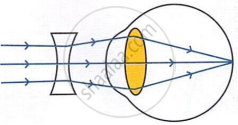
- Name the defect that has been corrected. Which type of lens has been used for the correction?
- Mention one cause for the above defect.
- Where would the image have formed if the above lens was not used for correction?
- Name the three concentric layers of the eyeball.
- Draw a neat, labelled diagram of a neuron.
- Draw a well-labelled diagram of the membranous labyrinth found in the inner ear.
- Based on the diagram drawn above in (i), give a suitable term for each of the following descriptions:
- The sensory cells that help in hearing.
- The part that is responsible for static balance of the body.
- The membrane-covered opening that connects the middle ear to the inner ear.
- The fluid present in the middle chamber of cochlea.
- The structure that maintains dynamic equilibrium of the body.
DO IT RIGHT
When you go to an ophthalmologist for getting your eyes checked, you are asked to identify letters on a board kept at a fixed distance. Make a similar board using a cardboard or thermocol with letters replicating the original board. Test the eyesight of your friends, classmates, parents, teachers, neighbours and grandparents. Make a data table containing figures of the number of people with normal eye sight and defective eye sight.
Ask your teacher about how people deal with hearing problems.
- How do doctors detect that a child has hearing problems? Learn about hearing devices/aids for children and elders. Make a list of the latest hearing aids/devices.
- Do people have hearing problems from birth or it can develop over time?
- What are the reasons people suddenly turn deaf?
Solutions for 11: Sense Organs
Lakhmir Singh solutions for बायोलॉजी [इंग्रजी] इयत्ता १० आईसीएसई chapter 11 - Sense Organs
Shaalaa.com has the CISCE Mathematics बायोलॉजी [इंग्रजी] इयत्ता १० आईसीएसई CISCE solutions in a manner that help students grasp basic concepts better and faster. The detailed, step-by-step solutions will help you understand the concepts better and clarify any confusion. Lakhmir Singh solutions for Mathematics बायोलॉजी [इंग्रजी] इयत्ता १० आईसीएसई CISCE 11 (Sense Organs) include all questions with answers and detailed explanations. This will clear students' doubts about questions and improve their application skills while preparing for board exams.
Further, we at Shaalaa.com provide such solutions so students can prepare for written exams. Lakhmir Singh textbook solutions can be a core help for self-study and provide excellent self-help guidance for students.
Concepts covered in बायोलॉजी [इंग्रजी] इयत्ता १० आईसीएसई chapter 11 Sense Organs are .
Using Lakhmir Singh बायोलॉजी [इंग्रजी] इयत्ता १० आईसीएसई solutions Sense Organs exercise by students is an easy way to prepare for the exams, as they involve solutions arranged chapter-wise and also page-wise. The questions involved in Lakhmir Singh Solutions are essential questions that can be asked in the final exam. Maximum CISCE बायोलॉजी [इंग्रजी] इयत्ता १० आईसीएसई students prefer Lakhmir Singh Textbook Solutions to score more in exams.
Get the free view of Chapter 11, Sense Organs बायोलॉजी [इंग्रजी] इयत्ता १० आईसीएसई additional questions for Mathematics बायोलॉजी [इंग्रजी] इयत्ता १० आईसीएसई CISCE, and you can use Shaalaa.com to keep it handy for your exam preparation.
