Advertisements
Online Mock Tests
Chapters
1: Cell Cycle and Cell Division
2: Structure of Chromosome
3: Genetics
Unit 2: Plant Physiology
4: Absorption by Roots
5: Transpiration
6: Photosynthesis
7: Chemical Coordination in Plants
Unit 3: Human Anatomy and Physiology
8: Circulatory System
9: Human Excretory System
▶ 10: Nervous System
11: Sense Organs
12: Endocrine System
13: Reproductive System
Unit 4: Population
14: Population
Unit 5: Human Evolution
Chapter 15: Human Evolution
Unit 6: Pollution
Chapter 16: Pollution
![Lakhmir Singh solutions for बायोलॉजी [इंग्रजी] इयत्ता १० आईसीएसई chapter 10 - Nervous System - Shaalaa.com](/images/biology-english-class-10-icse_6:7181a54a5d284da8b50dd2f92022a1f6.jpg "Lakhmir Singh solutions for बायोलॉजी [इंग्रजी] इयत्ता १० आईसीएसई chapter 10 - Nervous System")
Advertisements
Solutions for Chapter 10: Nervous System
Below listed, you can find solutions for Chapter 10 of CISCE Lakhmir Singh for बायोलॉजी [इंग्रजी] इयत्ता १० आईसीएसई.
Lakhmir Singh solutions for बायोलॉजी [इंग्रजी] इयत्ता १० आईसीएसई 10 Nervous System Intex Quesion [Pages 161 - 168]
TEST YOUR UNDERSTANDING - 1
True or False.
Nervous system helps in the interaction of the body with both its internal and external environment.
True or False.
Dendron is a long fibre which terminates into bulb-like structures called synaptic knobs.
True or False.
Sensory neurons are the most abundant type of neurons.
True or False.
The ganglia act as relay stations for the body's nervous system.
True or False.
Action potential is generated when the nerve is repolarised.
Fill in the Blanks
________ are the chemicals released at the synaptic junction.
The receptor in a sense organ is in touch with the ________ of sensory neuron.
There are ______ types of neurons.
The neuron is made up of ________, ________ and ________.
________ are a cluster of neurons enclosed within a sheath.
THINK AND ANSWER
Why do you think a person is not able to walk straight after consuming alcohol?
What will be the consequence if the medulla of a person gets damaged in an accident?
TEST YOUR UNDERSTANDING - 2
Give One Word Answer:
The layers that acts as a cushion to the brain and spinal cord.
Give One Word Answer:
Pons, cerebellum and medulla oblongata are parts of this brain.
Name the following:
The part of the brain associated with memory.
Give One Word Answer:
Fluid that fills space in ventricles of the brain.
Give One Word Answer:
A nerve that connects two hemispheres of cerebrum.
Give One Word Answer:
Thalamus and hypothalamus are part of this section of the brain.
Give One Word Answer:
Another name for midbrain.
Give One Word Answer:
Nerve end of the spinal cord shaped like horse tail.
Fill in the Blanks
The ______ and ______ are covered by three-layered tissue called meninges.
______ is the largest part of the brain and divided into left and right ______.
______ is the triangular part located at the base of the brain which connects the brain to the spinal cord.
TEST YOUR UNDERSTANDING - 3
A type of action involving peripheral nervous system and spinal cord.
Stimulus action
Reflex action
Beating of heart
Hormonal action
One is not an example of natural reflex. Tick the correct option.
Blinking of an eye when an insect comes near
Dripping of saliva from a dog on hearing a bell
Playing guitar with eyes closed
Movement of food in oesophagus
Fill in the Blanks
Decrease of heartbeat pressure is regulated by ________.
________ involves the spinal cord for quick response to stimuli.
________ and ________ are part of central nervous system.
Playing a piano with closed eyes is an example of ________ reflex.
There are ______ types of reflexes.
______, ______ and ______ are the three types of nerves.
Peripheral nervous system is divided into two parts: ______ and ______.
Lakhmir Singh solutions for बायोलॉजी [इंग्रजी] इयत्ता १० आईसीएसई 10 Nervous System EXERCISE [Pages 171 - 174]
Objective Questions
True or False.
Sodium is needed for transmission of nerve impulse.
True or False.
Sensory neurons convey receptors from the receptor to the brain and spinal cord.
True or False.
Meningitis is the inflammation of the spinal cord.
True or False.
The two cerebral hemispheres are connected by the pons.
True or False.
Cerebrum controls our heart's heartbeat.
Fill in the Blanks
______ is the point of contact between the two neurons.
The folds of the grey matter in the brain are called the ______ and the grooves are called the ______.
The cavities in the brain are called ______.
______ reflex is one which is developed during the lifetime.
Long thread-like place of a nerve cell is ______.
Match the Following:
| Column I | Column II |
|---|---|
| (i) Nerves extending from spinal cord | (a) Butterfly shaped |
| (ii) Grey matter of spinal cord | (b) Bulb shaped |
| (iii) Controls auditory impulses | (c) Horse tail shaped |
| (iv) Synaptic knob | (d) 31 pairs |
| (v) Unconditional reflex | (e) Midbrain |
| (vi) Spinal nerve | (f) Natural |
Give One Word Answer:
Name of the organ that responds to the motor nerves.
Give One Word Answer:
Unconscious and quick response to a stimulus.
Name the following:
The part of the human brain which controls body temperature.
Name the following:
Unit of the nervous system is
Give One Word Answer:
The most important part of the nervous system.
Name the following:
The part of the brain which is concerned with memory.
Multiple Choice Questions
Which of the following is an effect of sympathetic nervous system?
Increase in heart rate
Decrease in peristalsis
Dilation of pupil
All of these
The gap between two myelin sheath is called ______.
Synapse
Corpus callosum
Nodes of Ranvier
Vitreous chamber
The neurotransmitter carrying impulse to the next neuron is ______.
action potential
acetylcholine
Nissl's granules
visual purple
Which of the following terms is associated with the transmission of nerve impulse?
Depolarisation
Repolarisation
Sodium pump
All of these
Of all the parts of the brain, ______ is the largest.
Cerebrum
Pons
Cerebellum
Medulla oblongata
The ventral root ganglion of the spinal cord contains cell bodies of ______.
motor neuron
sensory neuron
intermediate neuron
associated neuron
The main pathway for the information connecting the brain and the peripheral nervous system is ______.
Cerebrum
Pons
Spinal cord
Hypothalamus
The cranial nerves are ______.
12 pairs
31 pairs
42 pairs
8 pairs
Which one of the following associated with the maintenance of the posture?
Cerebrum
Cerebellum
Thalamus
Pons
A reflex arc in man is best described as movement of stimuli from:
Receptor cell, sensory neuron, relaying neuron, effector muscles
Receptor cell, efferent nerve, relaying neuron, muscles of the body
Receptor cell, spinal cord, motor neuron, relaying neuron
Receptor cell, synapse, motor neuron, relaying neuron
Which of the following is not a natural reflex action?
Knee-jerk
Blinking of eyes due to strong light
Salivation at the sight of food
Sneezing when any irritant enters the nose
The number of Spinal nerves in a human being are ______.
31 pairs
10 pairs
21 pairs
30 pairs
Correct and rewrite the statements by changing the biological term that is underlined for the statement:
Mainitaining balance of the body and coordinating muscular activities is carried out by the cerebrum.
Correct the following statement by changing the underlined word.
The outermost layer of Meninges is Pia mater.
Choose the Odd One Out:
Cyton
Photon
Axon
Dendron
Descriptive Questions Short Answer Questions
State the importance of the synaptic transmission.
Explain the different types of nerves and their role in nervous system.
State the functions of thalamus.
State the functions of hypothalamus.
Discuss the importance of nodes of Ranvier.
Justify the statement, “Salivation is both a natural and conditioned reflex.”
What is the three-layered tissue covering the brain and the spinal cord? Briefly explain.
Define:
Synapse
Define:
Ganglion
Define the following term:
Nerve
Define:
Medulla oblongata
Define:
Meninges
Differentiate between Dendrites and axons.
Distinguish between Afferent neurons and efferent neurons.
Distinguish between
Sympathetic and parasympathetic nervous system.
What is the difference between reflex action and voluntary action?
Compare the following:
Central neural system (CNS) and Peripheral neural system (PNS)
Differentiate between the Following:
Somatic and Autonomic nervous system
Long Answer Questions
Discuss the role of sodium in the transmission of the nerve impulse.
Define the following:
Reflex action
Describe the path of reflex arc. What is its importance?
Describe the different parts of the brain.
Explain the structure of neuron with the help of a labelled diagram.
Give a brief account of peripheral nervous system.
Diagram Based Questions
The diagram given below shows the internal structure of a spinal cord depicting a phenomena. Study the diagram and answer the questions:
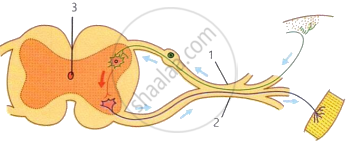
- Name the phenomenon that is depicted in the diagram. Define the phenomenon.
- Give the technical term for the point of contact between the two nerve cells.
- Name the parts numbered 1, 2 and 3.
- How does the arrangement of neurons in the spinal cord differ from that of the brain?
- Mention two ways by which the spinal cord is protected in our body.
The diagram given here is an external view of the human brain. Study the same and answer the questions that follow.
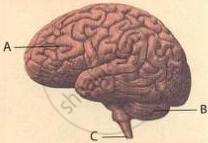
- Name the parts labelled A, B and C in the diagram.
- State the main functions of the parts labelled A and B.
- What are the structural and functional units of the brain? How are the parts of these units arranged in A and B?
- Mention the collective term for the membranes covering the brain.
- What is the function of cerebrospinal fluid?
DO IT RIGHT
Make a flowchart (cut-outs) for your class bulletin board. Take help as given in the chapter.
Make a video on parasympathetic and sympathetic nervous system for your class demonstration. Add your explanation in the form of an audio in it. Save your video in MP4 file format.
Have you heard about Alzheimer's disease or motor neuron disorder? Search and find out why they occur and whether they are curable or not.
Solutions for 10: Nervous System
Lakhmir Singh solutions for बायोलॉजी [इंग्रजी] इयत्ता १० आईसीएसई chapter 10 - Nervous System
Shaalaa.com has the CISCE Mathematics बायोलॉजी [इंग्रजी] इयत्ता १० आईसीएसई CISCE solutions in a manner that help students grasp basic concepts better and faster. The detailed, step-by-step solutions will help you understand the concepts better and clarify any confusion. Lakhmir Singh solutions for Mathematics बायोलॉजी [इंग्रजी] इयत्ता १० आईसीएसई CISCE 10 (Nervous System) include all questions with answers and detailed explanations. This will clear students' doubts about questions and improve their application skills while preparing for board exams.
Further, we at Shaalaa.com provide such solutions so students can prepare for written exams. Lakhmir Singh textbook solutions can be a core help for self-study and provide excellent self-help guidance for students.
Concepts covered in बायोलॉजी [इंग्रजी] इयत्ता १० आईसीएसई chapter 10 Nervous System are .
Using Lakhmir Singh बायोलॉजी [इंग्रजी] इयत्ता १० आईसीएसई solutions Nervous System exercise by students is an easy way to prepare for the exams, as they involve solutions arranged chapter-wise and also page-wise. The questions involved in Lakhmir Singh Solutions are essential questions that can be asked in the final exam. Maximum CISCE बायोलॉजी [इंग्रजी] इयत्ता १० आईसीएसई students prefer Lakhmir Singh Textbook Solutions to score more in exams.
Get the free view of Chapter 10, Nervous System बायोलॉजी [इंग्रजी] इयत्ता १० आईसीएसई additional questions for Mathematics बायोलॉजी [इंग्रजी] इयत्ता १० आईसीएसई CISCE, and you can use Shaalaa.com to keep it handy for your exam preparation.
