Advertisements
Advertisements
Predict the direction of induced current in the situation described by the following figure.

Concept: undefined >> undefined
Use Lenz’s law to determine the direction of induced current in the situation described by the figure.
A circular loop being deformed into a narrow straight wire.

Concept: undefined >> undefined
Advertisements
Write Maxwell's generalization of Ampere's circuital law. Show that in the process of charging a capacitor, the current produced within the plates of the capacitor is `I=varepsilon_0 (dphi_E)/dt,`where ΦE is the electric flux produced during charging of the capacitor plates.
Concept: undefined >> undefined
Write Maxwell's generalization of Ampere's circuital law. Show that in the process of charging a capacitor, the current produced within the plates of the capacitor is `I=varepsilon_0 (dphi_E)/dt,`where ΦE is the electric flux produced during charging of the capacitor plates.
Concept: undefined >> undefined
Explain any two factors that justify the need of modulating a low-frequency signal.
Concept: undefined >> undefined
(i) State Bohr's quantization condition for defining stationary orbits. How does the de Broglie hypothesis explain the stationary orbits?
(ii) Find the relation between three wavelengths λ1, λ2 and λ3 from the energy-level diagram shown below.
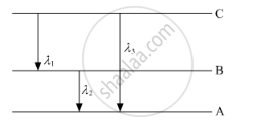
Concept: undefined >> undefined
Define an equipotential surface.
Concept: undefined >> undefined
A signal of 5 kHz frequency is amplitude modulated on a carrier wave of frequency 2 MHz. What are the frequencies of the side bands produced?
Concept: undefined >> undefined
State Ampere’s circuital law.
Concept: undefined >> undefined
Draw a sketch of equipotential surfaces due to a single charge (-q), depicting the electric field lines due to the charge
Concept: undefined >> undefined
State Bohr’s postulate of hydrogen atom which successfully explains the emission lines in the spectrum of hydrogen atom. Use Rydberg formula to determine the wavelength of Hα line. [Given: Rydberg constant R = 1.03 × 10⁷ m−1]
Concept: undefined >> undefined
Electron drift speed is estimated to be of the order of mm s−1. Yet large current of the order of few amperes can be set up in the wire. Explain briefly.
Concept: undefined >> undefined
Draw a block diagram of a detector for AM signal and show, using necessary processes and the waveforms, how the original message signal is detected from the input AM wave.
Concept: undefined >> undefined
Using Bohr's postulates of the atomic model, derive the expression for radius of nth electron orbit. Hence obtain the expression for Bohr's radius.
Concept: undefined >> undefined
Explain the process of amplitude modulation.
Concept: undefined >> undefined
A regular hexagon of side 10 cm has a charge 5 µC at each of its vertices. Calculate the potential at the centre of the hexagon.
Concept: undefined >> undefined
Two charges 2 μC and −2 µC are placed at points A and B 6 cm apart.
- Identify an equipotential surface of the system.
- What is the direction of the electric field at every point on this surface?
Concept: undefined >> undefined
Describe schematically the equipotential surfaces corresponding to
(a) a constant electric field in the z-direction,
(b) a field that uniformly increases in magnitude but remains in a constant (say, z) direction,
(c) a single positive charge at the origin, and
(d) a uniform grid consisting of long equally spaced parallel charged wires in a plane.
Concept: undefined >> undefined
The top of the atmosphere is at about 400 kV with respect to the surface of the earth, corresponding to an electric field that decreases with altitude. Near the surface of the earth, the field is about 100 Vm−1. Why then do we not get an electric shock as we step out of our house into the open? (Assume the house to be a steel cage so there is no field inside!)
Concept: undefined >> undefined
A man fixes outside his house one evening a two metre high insulating slab carrying on its top a large aluminium sheet of area 1 m2. Will he get an electric shock if he touches the metal sheet next morning?
Concept: undefined >> undefined
