Please select a subject first
Advertisements
Advertisements
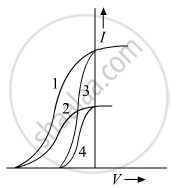
The given graph shows the variation of photo-electric current (I) versus applied voltage (V) for two difference photosensitive materials and for two different intensities of the incident radiations. Identify the pairs of curves that correspond to different materials but same intensity of incident radiation.
Concept: undefined >> undefined
Block diagram of a receiver is shown in the figure:
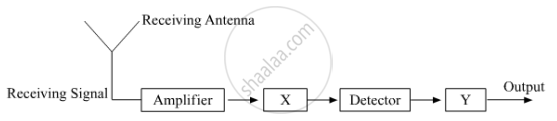
(a) Identify ‘X’ and ‘Y’.
(b) Write their functions.
Concept: undefined >> undefined
Advertisements
In a series LCR circuit connected to an ac source of variable frequency and voltage ν = vm sin ωt, draw a plot showing the variation of current (I) with angular frequency (ω) for two different values of resistance R1 and R2 (R1 > R2). Write the condition under which the phenomenon of resonance occurs. For which value of the resistance out of the two curves, a sharper resonance is produced? Define Q-factor of the circuit and give its significance.
Concept: undefined >> undefined
When monochromatic light travels from a rarer to a denser medium, explain the following, giving reasons:
(i) Is the frequency of reflected and refracted light same as the frequency of incident light?
(ii) Does the decrease in speed imply a reduction in the energy carried by light wave?
Concept: undefined >> undefined
A wheel with 8 metallic spokes each 50 cm long is rotated with a speed of 120 rev/min in a plane normal to the horizontal component of the Earth’s magnetic field. The Earth’s magnetic field at the place is 0.4 G and the angle of dip is 60°. Calculate the emf induced between the axle and the rim of the wheel. How will the value of emf be affected if the number of spokes were increased?
Concept: undefined >> undefined
Distinguish between ‘Analog and Digital signals’.
Concept: undefined >> undefined
Write any two factors which justify the need for modulating a signal ?
Concept: undefined >> undefined
Draw a diagram showing an amplitude modulated wave by superposing a modulating signal over a sinusoidal carrier wave.
Concept: undefined >> undefined
A proton and an electron have same kinetic. Which one has greater de-Broglie wavelength and why?
Concept: undefined >> undefined
The ground state energy of hydrogen atom is −13.6 eV. If and electron make a transition from the energy level −0.85 eV to −3.4 eV, calculate spectrum does his wavelength belong?
Concept: undefined >> undefined
Explain briefly the principle on which a transistor-amplifier works as an oscillator. Draw the necessary circuit diagram and explain its working ?
Concept: undefined >> undefined
A proton and an electron have same velocity. Which one has greater de-Broglie wavelength and why?
Concept: undefined >> undefined
The ground state energy of hydrogen atom is −13.6 eV. If an electron make a transition from an energy level −0.85 eV to −1.51 eV, calculate the wavelength of the spectral line emitted. To which series of hydrogen spectrum does this wavelength belong?
Concept: undefined >> undefined
Show on a graph the variation of the de Broglie wavelength (λ) associated with an electron, with the square root of accelerating potential (V) ?
Concept: undefined >> undefined
When monochromatic light is incident on a surface separating two media, why does the refracted light have the same frequency as that of the incident light?
Concept: undefined >> undefined
Obtain the conditions for the bright and dark fringes in diffraction pattern due to a single narrow slit illuminated by a monochromatic source.
Explain clearly why the secondary maxima go on becoming weaker with increasing.
Concept: undefined >> undefined
Using de Broglie’s hypothesis, explain with the help of a suitable diagram, Bohr’s second postulate of quantization of energy levels in a hydrogen atom.
Concept: undefined >> undefined
Write briefly any two factors which demonstrate the need for modulating a signal. Draw a suitable diagram to show amplitude modulation using a sinusoidal signal as the modulating signal.
Concept: undefined >> undefined
State Huygen’s principle. Using this principle explain how a diffraction pattern is obtained on a screen due to a narrow slit on which a narrow beam coming from a `=> n = (vlamda)/(vlamda_omega)`monochromatic source of light is incident normally.
Concept: undefined >> undefined
If a monochromatic source of light is replaced by white light, what change would you observe in the diffraction pattern?
Concept: undefined >> undefined
