Advertisements
Advertisements
प्रश्न
Show on a graph the variation of the de Broglie wavelength (λ) associated with an electron, with the square root of accelerating potential (V) ?
Advertisements
उत्तर
`lambda = 1.22/sqrtV`
`therefore lambda sqrtV=` const
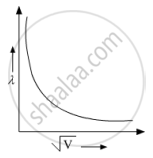
Hence, we get a hyperbola.
संबंधित प्रश्न
A proton and an α -particle are accelerated through the same potential difference. Which one of the two has greater de-Broglie wavelength Justify your answer.
An α-particle and a proton are accelerated through the same potential difference. Find the ratio of their de Broglie wavelength.
State de Broglie hypothesis
A proton and an alpha particle are accelerated through the same potential. Which one of the two has (i) greater value of de−Broglie wavelength associated with it and (ii) less kinetic energy. Give reasons to justify your answer.
An electron is accelerated through a potential difference of 64 volts. What is the de-Broglie wavelength associated with it? To which part of the electromagnetic spectrum does this value of wavelength correspond?
Consider the de-Broglie wavelength of an electron and a proton. Which wavelength is smaller if the two particles have (a) the same speed (b) the same momentum (c) the same energy?
A running man has half the kinetic energy of that of a boy of half of his mass. The man speeds up by 1 m/s so as to have the same K.E. as that of the boy. The original speed of the man will be:
The de- Broglie wave length of an electron moving with a speed of 6.6 × 10⁵ m/s is approximately
For what k.e of neutron will the associated de-Broglie wavelength be 1.40 × 10⁻¹⁰ m? mass of neutron= 1.675 × 10⁻²⁷ kg, h = 6.63 × 10⁻³⁴ J
A strong argument for the particle mature of cathode ray is to
