Advertisements
Advertisements
प्रश्न
Show on a graph the variation of the de Broglie wavelength (λ) associated with an electron, with the square root of accelerating potential (V) ?
Advertisements
उत्तर
`lambda = 1.22/sqrtV`
`therefore lambda sqrtV=` const
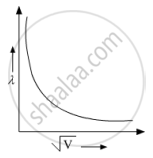
Hence, we get a hyperbola.
संबंधित प्रश्न
Calculate the de Broglie wavelength of an electron moving with - of the speed of light in vacuum (Negelct relativistic effect)
(Planck's constant: h = 6.63 x 10⁻³⁴ Js, Mass of electron : m = 9.11 x 10⁻²⁸ g)
A deuteron and an alpha particle are accelerated with the same accelerating potential greater value of de-Broglie wavelength, associated it ?
Using de Broglie’s hypothesis, explain with the help of a suitable diagram, Bohr’s second postulate of quantization of energy levels in a hydrogen atom.
Let p and E denote the linear momentum and energy of a photon. If the wavelength is decreased,
Light of wavelength 2000 Å falls on a metal surface of work function 4.2 eV.
If the same light falls on another surface of work function 6.5 eV, what will be the energy of emitted electrons?
When the displacement of a particle executing simple harmonic motion is half of its amplitude, the ratio of its kinetic energy to potential energy is:
A proton is accelerated through one volt the increase in its kinetic energy is approximately
For production of characteristic of X-rays the electron trans mission is
For what k.e of neutron will the associated de-Broglie wavelength be 1.40 × 10⁻¹⁰ m? mass of neutron= 1.675 × 10⁻²⁷ kg, h = 6.63 × 10⁻³⁴ J
The work function of a metal is 4.50 eV. Find the frequency of light to be used to eject electrons from the metal surface with a maximum kinetic energy of 6.06 × 10⁻¹⁹ J.
