Advertisements
Advertisements
Question
Show on a graph the variation of the de Broglie wavelength (λ) associated with an electron, with the square root of accelerating potential (V) ?
Advertisements
Solution
`lambda = 1.22/sqrtV`
`therefore lambda sqrtV=` const
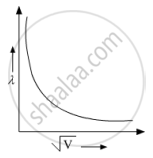
Hence, we get a hyperbola.
RELATED QUESTIONS
Calculate the de-Broglie wavelength of an electron moving with one-fifth of the speed of light.Neglect relativistic effects. (`h = 6.63 xx 10^(-34)` J.s, c= `3xx10^8`m/s, mass of electron = `9 xx 10^(-31) kg)`
State how de-Broglie wavelength (`lambda`) of moving particles varies with their linear momentum (p).
A proton and an electron have same velocity. Which one has greater de-Broglie wavelength and why?
An electron, an alpha particle and a proton have the same kinetic energy.
Which one of these particles has the largest de-Broglie wavelength?
A proton and an electron are accelerated by the same potential difference. Let λe and λpdenote the de Broglie wavelengths of the electron and the proton, respectively.
Gas exerts pressure on the walls of the container because :
When the displacement of a particle executing simple harmonic motion is half of its amplitude, the ratio of its kinetic energy to potential energy is:
A running man has half the kinetic energy of that of a boy of half of his mass. The man speeds up by 1 m/s so as to have the same K.E. as that of the boy. The original speed of the man will be:
A proton is accelerated through one volt the increase in its kinetic energy is approximately
What is meant by “Dual nature of matter”?
