Please select a subject first
Advertisements
Advertisements
Why should the wires carrying electricity not be touched barefooted?
Concept: Household Electrical Circuits
The device used for producing electric current is called a ______.
Concept: Alternating-Current Generator
State whether the following statement is true or false.
An electric motor converts mechanical energy into electrical energy.
Concept: Electric Motor
State the right-hand thumb rule.
Concept: Right-hand Thumb Rule
Explain the construction and working of an electric motor.
Concept: Electric Motor
Label the four parts of an electric motor

Concept: Electric Motor
write two uses of DC motor
Concept: Simple D.C. Motor
Observe the following figure:

If the current in the coil A is changed, will some current be induced in the coil B? Explain.
Concept: Force on a Current-Carrying Conductor Placed in a Uniform Magnetic Field
Tell the odd one out. Give a proper explanation.
Concept: Electric Motor
Name the following diagram and explain the concept behind it.
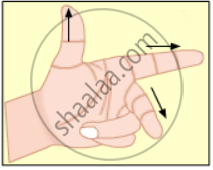
Concept: Force on a Current-Carrying Conductor Placed in a Uniform Magnetic Field
i) Which principle is explained in this figure?
ii) Which rule is used to find out the direction of a force in this principle?
iii) In which machine this principle is used? Draw a diagram showing working of that machine
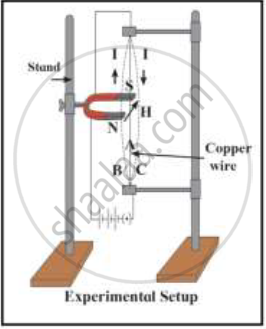
Concept: Force on a Current-Carrying Conductor Placed in a Uniform Magnetic Field
Observe the figure and answer the following questions.
a) Identify the machine shown in figure.
b) Write a use of this machine.
c) How transformation of energy takes place in this machine.
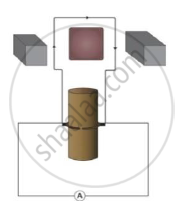
Concept: Alternating-Current Generator
Study the following principle and answer the question.
A force is excreted on the current carrying conductor. The direction of this force depends on both the direction of the current and the direction of the magnetic field. This force is maximum when the direction of current is perpendicular to the direction of the magnetic field.
a) By which law we can determine the direction of force excreted on the current carrying conductor.
b) In which electrical equipment this principle is used.
c) Draw a diagram representing construction of this equipment.
d) Write the working of this equipment in brief.
Concept: Electric Motor
Differentiate between conductors and insulators.
Concept: Force on a Current-Carrying Conductor Placed in a Uniform Magnetic Field
State Fleming’s Right Hand Rule.
Concept: Introduction to Electromagnetic Induction
Answer the following:
State the principles of the electric motor and electric generator.
Concept: Introduction to Electromagnetic Induction
Answer the following question:
What is overloading? When does it occur? How can overloading be avoided?
Concept: Household Electrical Circuits
Choose the correct option:
A conductor rod of length (l) is moving with velocity (v) in a direction normal to a uniform magnetic field (B). What will be the magnitude of induced emf produced between the ends of the moving conductor?
Concept: Introduction to Electromagnetic Induction
State true or false:
The frequency of AC is 50 Hz.
Concept: Alternating-Current Generator
Observe the given figure of Fleming’s Right Hand Rule and write the labels of A and B correctly.
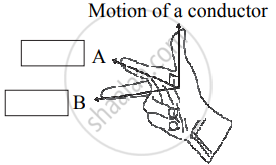
Concept: Introduction to Electromagnetic Induction
