Advertisements
Advertisements
State True or False:
"Wavelength of red light is close to 700 nm.”
Concept: Dispersion of Light Through a Prism
Observe the given diagram and answer the questions:
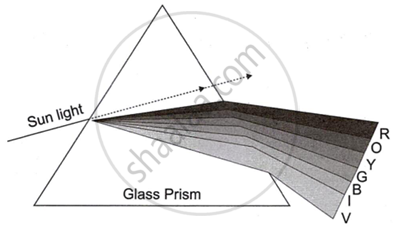
- Name the process shown in the figure.
- Name the colour that deviates the most.
- Name the colour that deviates the least.
- Name any one phenomenon in nature which is based on the above process.
- Define ‘spectrum’.
Concept: Dispersion of Light Through a Prism
Calculate the focal length of a corrective lens having power +2D.
Concept: Power of a Lens
In a Std. X class out of 40 students 10 students use spectacles, 2 students have positive power and 8 students have negative power of lenses in their spectacles.
Answer the following questions:
(1) What does the negative power indicate?
(2) What does the positive power indicate?
(3) Generally which type of spectacles do most of the students use?
(4) What defect of eyesight do most of the students suffer from?
(5) Give two possible reasons for the above defect.
Concept: Defects of Vision and Their Corrections > Myopia
Calculate the focal length of a corrective lens having power +2.5 D.
Concept: Power of a Lens
What is myopia?
Concept: Defects of Vision and Their Corrections > Myopia
Explain two possible reasons of myopia. How can it be corrected? Explain with a suitable diagram.
Concept: Defects of Vision and Their Corrections > Myopia
Kavita from 10th is using spectacles. The power of the lenses in her spectacles is –2.5 dioptre. Answer the following questions:
1) Which lenses are used in her spectacles?
2) State the defect of vision Kavita is suffering from.
3) Find the focal length of the lenses used in her spectacles
Concept: Power of a Lens
An object is held 20 cm away from a converging lens of focal length 10 cm. Find the position of the image formed.
Concept: Magnification
Name the defect shown in the diagram.

Concept: Defects of Vision and Their Corrections > Hypermetropia
At which position will you keep an object in front of convex lens to get a real image smaller than the object? Draw a figure.
Concept: Magnification
Observer the following diagram and answer the questions.
a) Which eye defect is shown in this diagram?
b) What are the possible reasons for this eye defect?
c) How this defect is corrected, write it in brief?

Concept: Defects of Vision and Their Corrections > Myopia
Surabhi from std. X uses spectacle. The power of the lenses in her spectacle is 0.5 D.
Answer the following questions from the given information:
- Identify the type of lenses used in her spectacle.
- Identify the defect of vision Surabhi is suffering from.
- Find the focal length of the lenses used in her spectacle.
Concept: Power of a Lens
Rewrite the following table so as to match second and third column with first column.
|
Column I
|
Column II
|
Column III
|
|
(i) Myopia
|
Old age problem
|
Bifocal lens
|
|
(ii) Presbyopia
|
Nearsightedness
|
Concave lens.
|
Concept: Defects of Vision and Their Corrections > Myopia
Anuja cannot see the blackboard writing but she can see nearby things.
(a) What is the eye defect she is suffering from?
(b) State the possible reason for her defect.
(c) How is it corrected
Concept: Defects of Vision and Their Corrections > Myopia
Anuja’s father cannot see nearby objects clearly.
(a) What is the eye defect he is suffering from?
(b) How is it corrected?
Concept: Defects of Vision and Their Corrections > Presbyopia
In Myopia the human eye _______.
Concept: Defects of Vision and Their Corrections > Myopia
Write scientific reason.
Nearsightedness, this defect can be corrected by using spectacles with concave lens.
Concept: Defects of Vision and Their Corrections > Myopia
If focal length of a convex lens is 20 cm at what is the power of the lens?
Concept: Power of a Lens
Two convex lenses of focal length 30 cm and 10 cm each are kept in contact with each other. Find the power of their combination.
Concept: Combination of Lenses
