मराठी

SSC (Marathi Semi-English) इयत्ता १० वी - Maharashtra State Board Important Questions for Science and Technology 1

Advertisements
[object Object]
[object Object]
विषय
मुख्य विषय
अध्याय
Advertisements
Advertisements
Science and Technology 1
< prev  201 to 220 of 629  next > 

Find the odd one out and justify it.
Fuse wire, M.C.B., Rubber Gloves, Generator

Appears in 1 question paper
Chapter: [4] Effects of Electric Current
Concept: Electric Circuit

Why does tungsten metal used to make solenoid type coil in an electric bulb?

Appears in 1 question paper
Chapter: [4] Effects of Electric Current
Concept: Heating Effect of Electric Current

Observe the following figure which bulb get fuse?


Appears in 1 question paper
Chapter: [4] Effects of Electric Current
Concept: Electric Circuit

Study the following principle and answer the question.
A force is excreted on the current carrying conductor. The direction of this force depends on both the direction of the current and the direction of the magnetic field. This force is maximum when the direction of current is perpendicular to the direction of the magnetic field.
a) By which law we can determine the direction of force excreted on the current carrying conductor.
b) In which electrical equipment this principle is used.
c) Draw a diagram representing construction of this equipment.
d) Write the working of this equipment in brief.

Appears in 1 question paper
Chapter: [4] Effects of Electric Current
Concept: Electric Motor

Observe the following diagram and choose the correct alternative:

Appears in 1 question paper
Chapter: [4] Effects of Electric Current
Concept: Magnetic Effect of Electric Current

Two tungsten bulbs of power 50 W and 60 W work on 220 V potential difference. If they are connected in parallel, how much current will flow in the main conductor?

Appears in 1 question paper
Chapter: [4] Effects of Electric Current
Concept: Electric Circuit

Give scientific reason :
In the electric equipment producing heat e.g. iron, electric heater, boiler, toaster, etc., an alloy such as Nichrome is used, not pure metals.

Appears in 1 question paper
Chapter: [4] Effects of Electric Current
Concept: Heating Effect of Electric Current

Match the column ‘A’ with column ‘B’.

Column ‘A’
Column ‘B’
(1) Eka - boron
(a) Germanium
(2) Eka - Aluminium
(b) Scandium
(3) Eka - Silicon
(c) Gallium
Appears in 1 question paper
Chapter: [4] Effects of Electric Current
Concept: Electric Circuit
When the resistance of a conductor increases, the current ____________ .
Appears in 1 question paper
Chapter: [4] Effects of Electric Current
Concept: Magnetic Effect of Electric Current

Differentiate between conductors and insulators.

Appears in 1 question paper
Chapter: [4] Effects of Electric Current
Concept: Force on a Current Carrying Conductor in a Magnetic Field

State Fleming’s Right Hand Rule.

Appears in 1 question paper
Chapter: [4] Effects of Electric Current
Concept: Electromagnetic Induction

Answer the following:

State the principles of the electric motor and electric generator. 

Appears in 1 question paper
Chapter: [4] Effects of Electric Current
Concept: Electromagnetic Induction

Name any six domestic appliances based on the heating effect of electric current.

Appears in 1 question paper
Chapter: [4] Effects of Electric Current
Concept: Heating Effect of Electric Current

Rewrite the following statement by selecting the correct option:

1 A = ____________ mA.

Appears in 1 question paper
Chapter: [4] Effects of Electric Current
Concept: Heating Effect of Electric Current

Explain ‘Electric generator’ with the help of the following points:

  1. Diagram of an AC Generator with labelling
  2. Principle of an electric generator
  3. The function of slip rings
  4. Any two uses of a generator.
Appears in 1 question paper
Chapter: [4] Effects of Electric Current
Concept: Alternating current (AC) and Direct Current (DC)

Answer the following question:
what is the heating effect of the electric current? state any four applications of it?

Appears in 1 question paper
Chapter: [4] Effects of Electric Current
Concept: Heating Effect of Electric Current

Answer the following question:
State the effect on the magnetic needle in Oersted’s experiment when:  
(a) the current is passed through the wire.  
(b) the current through the wire is increased
(c) the current through the wire is reversed. 

Appears in 1 question paper
Chapter: [4] Effects of Electric Current
Concept: Magnetic Effect of Electric Current

Choose the correct option:

A conductor rod of length (l) is moving with velocity (v) in a direction normal to a uniform magnetic field (B). What will be the magnitude of induced emf produced between the ends of the moving conductor?

Appears in 1 question paper
Chapter: [4] Effects of Electric Current
Concept: Electromagnetic Induction

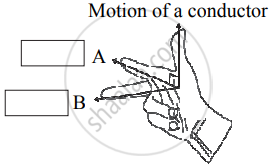
Observe the given figure of Fleming’s Right Hand Rule and write the labels of A and B correctly.
Appears in 1 question paper
Chapter: [4] Effects of Electric Current
Concept: Electromagnetic Induction

Read the given passage and answer the following questions:

The home electrical connection consists of ‘live’, ‘neutral’ and ‘earth’ wires. The ‘live’ and the ‘neutral’ wires have potential difference of 220 V. The ‘earth’ is connected to ground. Due to a fault in the equipment or if the plastic coating on the ‘live’ and the ‘neutral’ wires gives a way the two wires come in contact with each other and a large current flows through it producing heat. If any inflammable material (such as wood, cloth, plastic, etc.) exists around that place it can catch fire. Therefore a fuse wire is used as a precautionary measure.

  1. Name the two wires having potential difference of 220 V.
  2. What is a short circuit?
  3. Write the function of a fuse.
Appears in 1 question paper
Chapter: [4] Effects of Electric Current
Concept: Magnetic Effect of Electric Current
< prev  201 to 220 of 629  next > 
Advertisements
Advertisements
Maharashtra State Board SSC (Marathi Semi-English) इयत्ता १० वी Important Questions
Important Questions for Maharashtra State Board SSC (Marathi Semi-English) इयत्ता १० वी Algebra
Important Questions for Maharashtra State Board SSC (Marathi Semi-English) इयत्ता १० वी English (Second/Third Language)
Important Questions for Maharashtra State Board SSC (Marathi Semi-English) इयत्ता १० वी Geography [भूगोल]
Important Questions for Maharashtra State Board SSC (Marathi Semi-English) इयत्ता १० वी Geometry Mathematics 2
Important Questions for Maharashtra State Board SSC (Marathi Semi-English) इयत्ता १० वी Hindi (Second/Third Language) [हिंदी (दूसरी/तीसरी भाषा)]
Important Questions for Maharashtra State Board SSC (Marathi Semi-English) इयत्ता १० वी Hindi - Composite [हिंदी - संयुक्त]
Important Questions for Maharashtra State Board SSC (Marathi Semi-English) इयत्ता १० वी History and Political Science [इतिहास व राज्यशास्त्र]
Important Questions for Maharashtra State Board SSC (Marathi Semi-English) इयत्ता १० वी Marathi [मराठी]
Important Questions for Maharashtra State Board SSC (Marathi Semi-English) इयत्ता १० वी Sanskrit (Second Language) [संस्कृत (द्वितीय भाषा)]
Important Questions for Maharashtra State Board SSC (Marathi Semi-English) इयत्ता १० वी Sanskrit - Composite [संस्कृत - संयुक्त (द्वितीय भाषा)]
Important Questions for Maharashtra State Board SSC (Marathi Semi-English) इयत्ता १० वी Science and Technology 1
Important Questions for Maharashtra State Board SSC (Marathi Semi-English) इयत्ता १० वी Science and Technology 2
Share
Notifications

Englishहिंदीमराठी


      Forgot password?
Use app×